Paintings
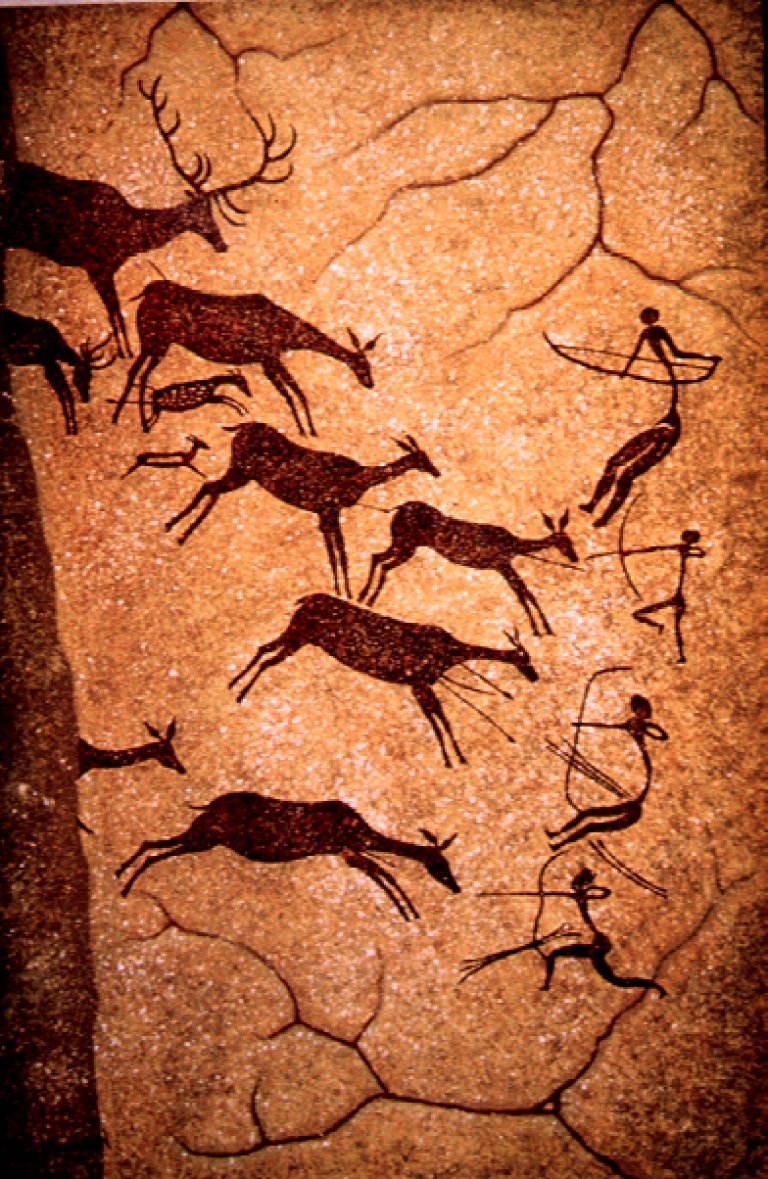
Cave Paintings
Botticelli – Mars & Venus
Van Goch – Night Café
Picasso – Camel
Edouard Manet – Bar at the Folies Bergere
Georges Seurat – The Bathers
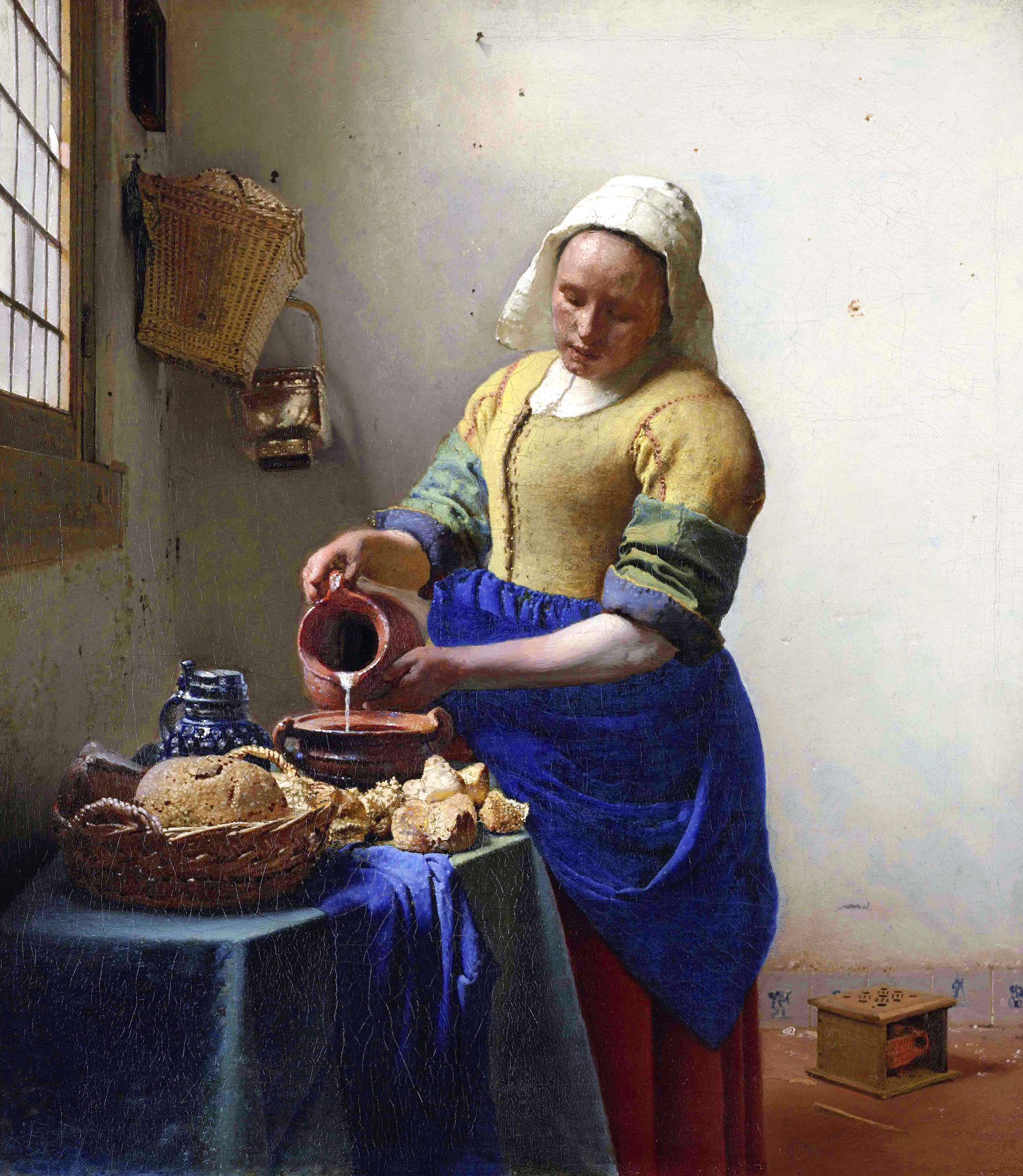
Jan Johannes Vermeer – The Milkmaid
Degas – Woman Drying Herself
Paul Cezanne – Basket of Apples
Toulouse Lautrec - Salon at the Rue des Moulins
Wassily Kandinsky – Yellow-Red-Blue
12. Mark Rothko – Triptych
Cave Paintings
The first picture added to my influence board is an example of the cave paintings at Lascaux. I have always admired the way that such beautiful, simple lines and shapes from 20,000 years ago can evoke the essence of an animal – something that I feel many more recent paintings of cattle fail to do - and a perfect demonstration of the principle that 'less' is often 'more'. I think this is because these images were not meant as decoration as such but as sacred descriptors of the quarry sought by the tribes-people who made them. Based on the lessons learned by studying examples of this work and Picasso's approach to drawing I have tried over the years to pare my designs down to their most basic, essential shapes.
Sandro Botticelli – Venus and Mars
This was the first painting that I ever fell in love with when I saw it in a book as as a small child and I still enjoy looking at it today. Beyond the obvious allegory that love conquers war, there are numerous coded meanings and references embedded within this painting. Efforts by scholars have uncovered some of them such as the narcotic power of the thorn apple held by one of the satyrs and the presence of wasps above Mars' sleeping head, symbolic both of his astrological influence (wasps being the insect sacred to the planet Mars) and of Simonetta Vespucci (the model for Venus) of whom he is apparently dreaming; part of this picture's charm is that the composition is slightly more formal than other Botticelli paintings of the period, very possibly as a result of accommodating such esoteric messages. Like most of his work it carries a feeling of having been a moment that was 'flash frozen' in time. There is so much implied movement in his work that had he been alive today, I feel that Botticelli might well have gone into the field of animation. The long languorous lines of the two human figures and their flowing garments are incomparably beautiful.
Vincent Van Goch – Night Café
Several of the paintings included in this list were hung along the staircase when I was growing up. We had very little money so these were not even particularly good reproductions but simply pictures that my mother seemed to have cut from a magazine of some kind and glued onto cardboard set behind flimsy frames. It is an endearing memory and I am very glad she did so because I came to know and love these pictures as a result of her efforts with scissors and glue. Van Gogh's 'Night Café' was one such image and is perhaps one of the reasons I am so interested in night photography now. The golden light trapped within the canopy, the sense of summer warmth still lingering in the night air as people stroll along the streets, the sky dotted with stars like daisies..I wanted to know how it was possible to make such things myself.
I was initially confused by the swirling brushstrokes but learned from my mother that each artist has a different voice and it is their purpose in life to share with others how the world appears through their unique eyes. This concept - with its almost Sufi-like overtones - has remained with me throughout my life.
Pablo Picasso – Camel
I have included this image of Picasso's camel as a perfect example of the 'less is more' axiom. Here he demonstrates what happens when he 'takes a line for a walk'. As in the cave paintings of Lascaux, he captures the essence of something, his hand and brain connected as one, the pen never leaving the page. Following Picasso's example I have tried to draw like this myself – with varying success. It is a soothing and meditative way to work and something I hope to take further, perhaps into animation if the opportunity arises.
Edouard Manet – Bar at the Folies Bergere and Georges Seurat – The Bathers
Together with Georges Seurat's 'The Bathers', this was another 'staircase picture' that got me thinking at a young age about how paint could be applied in ways that made no sense close up yet told an entire story from a distance. That the angle at which the wistful young barmaid and her customer (Manet himself) are reflected is at odds with the foreground only adds to the fascination of the image. Like the upright straw boater in 'The Bathers' reality sometimes needs to be sacrificed for the greater good of harmonious composition.
Jan Johannes Vermeer – The Milkmaid
In similar vein, Jan Johannes Vermeer has taken liberties with light in his joyful painting 'The Milkmaid' in order to create a radiant and arresting image. The wall behind her is too light, the wall beneath the window too dark and there is too much light overall playing on her garments, especially her skirt. If this were a photograph, it would need to have been lit from several angles to achieve this. Vermeer has also utilised ochre throughout the painting to complement the cobalt blues and throw the whole thing into sharp relief. Despite the striking clarity of the image, the style of this painting departures from the carefully modulated brush strokes of his previous work to something far bolder and more loose, in which detail takes second place to visual drama and overall intensity - whole sections of the maidservant's face and body have been simply blocked in light or shadow. It is a beautiful image and one which shows that a mundane subject can become a masterpiece if light is manipulated correctly.
Edgar Degas – Woman Drying Herself
Around 15 years ago I went to see the exhibition of Degas' pastels at the National Gallery. I have always loved his work and to see it close up was a rare and unforgettable privilege. This painting - amongst the many shown - was another 'staircase picture' from my childhood that I was delighted to be able to view in its original form. Whilst some people have tended to sentimentalise Degas' images of dancers, I have always felt that Degas viewed the female body as though it were that of an animal - women are seen going about their toilette in poses that are far from elegant or dignified - and the exhibition did nothing to persuade me otherwise. The most interesting aspect for me however was the evidence of the way that he worked, using tracing paper to produce multiple copies of the same image in order to experiment with how it looked reversed, or with the hues of the clothing completely altered. If Botticelli might have enjoyed animation then I think Degas would have loved using Photoshop!
Paul Cezanne – Basket of Apples
I have chosen this image by Cezanne because it exemplifies why he was such a central figure in painting. In his desire to simplify the hidden structures of nature into their basic components of cylinders, cones and spheres he bridged the old with the new and everyone who has studied painting has been influenced by his work, whether consciously or not. In many respects he was a pioneer who paved the way for the modernists who came afterwards and yet his work remains utterly accessible. This particular painting was one I wrote an essay about many years ago and it therefore has a cherished place on my page.
Toulouse Lautrec - Salon at the Rue des Moulins
This is a truly gorgeous, warm painting of the prostitutes at the Rue des Moulin. Like much of Lautrec's work, it is strongly influenced by Japanese block prints and the forms are laid out in bold, flat swathes, bordered by dark lines. Although the painterly women and the sketched background elements have been treated in very different ways the whole thing works well together, providing a strong and appealing narrative in rich, inviting hues. There are many reasons why I like this painting so much; the quirky composition is superb and the colours are delightful.
What I find most appealing of all however is the sense that the artist actually liked his subjects..there is a warmth here which is lacking in the work of Degas for example and it reminds me of a salutary lesson I learned a couple of years ago during a Coleg Harlech study visit to a Multimedia SME in Aberystwyth. We were played a corporate video that the five-man team had made for a London-based business client. It included a staged interview with the CEO promoting his products and was shown to us in order to demonstrate the multiple roles necessary for each member of the small multimedia team – largely animators by training - to possess. This demonstration however backfired somewhat, because although the animator who had filmed the interview for the client was pleased with his finished video and thought he was showing us a masterpiece, it was blindingly obvious to everyone else in the room that he actually loathed the interviewee and despised his values – when questioned afterwards he admitted as much. I cannot say exactly how this information came across in the video, but it was there, like a bad smell.
The lesson for me both in this story and the Lautrec painting is to be aware that one's views will inevitably colour the finished article, like a kind of creative DNA, so always try to find the enjoyable aspects of projects and keep them to the forefront of the mind whilst working.
Wassily Kandinsky – Yellow-Red-Blue
I have always found Kandinsky's visual work strangely compelling. I see shapes such as these in my dreams and assumed everyone else did also; it was a surprise to me when I learned that this is not the case. Spending time with his paintings is not so much a spiritual experience but rather an aesthetic one which puts me in the same dislocated and dreamlike part of myself that loves to explore a new place, absorbing the ambience without the need for language. Kandinsky was clearly synaesthetic and is work reflects this fact: perhaps this is why I find myself so drawn to it. I have included this picture as one of his lighter, less disturbingly intense compositions.
Mark Rothko – Triptych
Mark Rothko is an artist whose work I came to appreciate later in life. I must have been in my early thirties when I first saw his vast canvases exhibited at the Tate. I remember standing wordlessly in front of these huge paintings, unsure whether I was absorbing them or they were absorbing me. Some people find his work restful – I am not among them. Rothko's paintings cause me to feel engulfed and claustrophobic. He himself became frustrated during his lifetime by the attempts of critics and curators to define his work and retreated into silence concerning them and their meanings. It is fairly obvious however that these are not the paintings of a happy man. I have included them here because they evoke such powerful feelings in me. It is amazing that such a simple thing as a plane of colour on a canvas can elicit such a visceral response and further proof (if any were needed) that the role of the artist is indeed to share their personal vision of reality with the world.
Eras
Ancient Egypt
Ancient Greece
La Tène
Medieval
Tudor
Art Nouveaux
Art Deco
1950's
Ancient Egypt
The art of Ancient Egypt (3000 to 300 BCE ) that adorns the temples and tombs is essentially formal with little or no room for personal expression within it. It is the art of power, the art of the State. In the form of hieroglyphs it is there to inform and to invoke and in three-dimensions its purpose is often to overawe and intimidate.
I love this work for the implacably serene face it presents to the world and for the simplicity to which it reduces all forms. It has a recognisable style which carries with it an atmosphere and a feeling which I find difficult to define but it delights me to find a design element from Ancient Egypt incorporated into the arch of a 20th century Art Deco tunnel entrance or building.
When I lived in London I took regular trips to the British Museum just to sit in the Egyptian Rooms - sometimes for many hours - quietly absorbing the feeling of these incredible works of art. Over the years I have reproduced several Egyptian pictures onto papyrus as commissions or gifts for friends and family similarly enamoured of Egyptian art. Capturing the authentic feeling of these images is no easy feat because they are strangely difficult to copy accurately.
Ancient Greece
My mother, sister and brother were very interested in the Ancient Greek civilisation (800 BCE to 600 AD) and my earliest reading material consisted of modern translations of Greek myths, to the extent that I knew far more about the Ancient Greek pantheon than Christianity when I started school. Museum visits followed when I was a little older and a three-day trip to Athens and the surrounding Aegean Islands when I was 10 left a lasting impression on me. It was incredible to stand before and touch things I'd only seen in pictures until that point. The fact that so much of our academic, artistic and cultural heritage today is based on principles first outlined by these ancient people still amazes me. These temples, these images that leap out from frescoes and dance around ceramics still have an immediacy and artistic freedom accessible to us in our current time.
La Tène
I first became interested in design from the 'La Tène' culture when I moved to Wales thirty years ago. Whilst popularly referred to as 'Celtic', this kind of decoration was prevalent across the whole of Europe and much of Scandinavia during the late Iron Age (450 BCE to the Roman conquest in the 1st century BCE) and in Britain alone archaeological examples of this type of work can be found equally across Saxon, Pictish and Celtic sites. Some objects will have been traded from elsewhere, but there is also evidence for local manufacture, indicating a rich, historic exchange and ongoing development of ideas between races, rather than an 'in-house' style exclusive to one.
I love these objects because they are pure embellishment and joyful decoration and as such, they speak of a sense of wellbeing that comes from a settled lifestyle with the leisure to accumulate wealth and the symbols of status, much like our own cultures today.
The sensuality of the symmetrical (and occasionally asymmetrical) curves and the mathematical precision of the interlocking patterns; the lengths to which a natural form can be extended in order to complete an abstract idea; the solemn little faces atop these creations..all of these are reasons for me to love La Tène! Following an inspiring visit to the British Museum in the early 1980's to research this work more deeply, I began creating artwork of my own in imitation of this style, usually for commercial purposes.
The heyday of the Celtic Art revival is now long past but I would not be surprised to see a new form re-emerge over the next twenty years as the Celtic nations fight to establish a new identity in the 21st Century.
Medieval & Tudor
The period stretching from the 8th to the 16th centuries in Europe has always played a central role in my life – quite simply, this era has fascinated me for as long as I can remember and if I could travel back in time it would be to somewhere within this range (probably either the 11th century or the Tudor era). I feel that these cultures represent an authenticity which the modern world lacks.
Perhaps because I was born in an 11th Century house (that my mother happened to be renting temporarily) I have always felt exquisitely at home in buildings of this age – it would be no exaggeration to say that pretty much anything from the 17th Century onwards feels slightly alien and strangely lacking in some indefinable way. I have included images from this period therefore because they represent for me the slight, underlying discomfort against which I have to continually push in order to function effectively as a modern woman and artist in a modern world.
Art Nouveau (1890 - 1910)
This art movement is most strongly associated with the work of Czech artist Alphonse Mucha (1860 - 1939). A Slav by birth, he worked tirelessly to promote the identity of his culture during his lifetime. He is best known in the West however for his distinctive poster designs and illustrations. His style was decorative and frequently featured young women in floating garments of some indeterminate classical era draped amongst floral arrangements. Using bold, sensual outlines filled with flat surfaces of pastel colour he created images that went on to influence an entire generation of designers, artists and craftspeople. This style eventually became known as Art Nouveau – a term from which he tried to distance himself since he felt that he was simply working in the way that came naturally to him as a result of his Czech heritage rather than conforming to any fashionable style. His work reached a new audience during the 1960's when Art Nouveau underwent something of a revival. It was during this period that I fell in love his work and Art Nouveau in general. Even today I find myself enthralled by his curving outlines, his frozen confections of fabric and flowers, the serene beauty of his young female figures and the flatness of his surfaces.
Art Deco (1920 - 40)
Patricia Bayer, author of several books on the subject, describes Art Deco as "an architecture of ornament, geometry, energy, retrospection, optimism, colour, texture, light and at times even symbolism." Bayer, P. (1999). As geometric and linear as the Art Nouveau to which it was a reaction was curved and sensual, this design movement called upon many sources for inspiration, including cubism, modernism and the newly discovered archaeological remains of the ancient Egyptians, the Inca and the Aztecs.
Although this movement influenced most areas of design, its impact upon me has been mainly through the architecture and furnishings of the era and I prefer the somewhat modulated designs of the 1930's Streamline Moderne that incorporate curves and long horizontals to the harsher elements that marked its beginning in the 1920s. I am not sure why I like these structures and spaces so much but conclude it must be because I was exposed to them as a child growing up in the 1950's and 60's and they came somehow to symbolize security in an uncertain world.
1950's
Having been born into this decade, I was surrounded as a child by the designs not only of the 50's, but also the 30's, 40's and 60's. It was an eclectic and not altogether pleasant mix and I struggled during my early years to differentiate between the styles, a problem further exacerbated by the antiques and African art my parents collected. By the time I was in my teens however I had already begun to take an interest in 50's kitsch and as the appeal of this period began to grow on me I started wearing 1950's clothing and using fabric which was still available in charity shops back then, much in the same the way that 90's items are available now.
In popular culture, helped in part by the film The Truman Show (1998, Peter Weir) the 1950's have come to represent a bright and breezy period of innocent hope; of prettily-pinnied wives cleaning their sunlit houses to the strains of 'Housewives' Choice' on the radio in preparation for the homecoming of smiling commuter husbands in hats and ties; a time of spiky, African-influenced screen-printed textiles in maroons, sage greens and eggshell blues, of cocktail cabinets in the living room and a sparkling kitchen filled with enormous, labour-saving white goods that still retained traces of their Streamline Moderne ancestry. Little of this was true for the majority of people in Post War Britain of course, but it's fun to buy into the mythology and I am glad to see these designs working their way back into mainstream design at last.
Film
The Godfather
Scarface
Carlito's Way
Brazil
Twelve Monkeys
Fightclub
Brief Encounter
Remains of the Day
Inception
The Company of Wolves
Pulp Fiction
The Godfather, Scarface and Carlito's Way
The films included in this category are those that still delight me after many years. I am fascinated by the politics of power and how individuals change both morally and emotionally as a result of its acquisition.
For this reason The Godfather Parts I and II (1972-4, Francis Ford Coppola),
Carlito's Way (1993, Brian De Palma) and Scarface (1983, Brian De Palma) are high on my list of favourites. I have watched these movies many times, discovering new aspects at each viewing and as a result of my studies at Glyndwr I am also learning more about the screenplay, camera angles and editing techniques that have been used to create their narratives which further deepens my understanding of them. The Godfather I & II I find particularly interesting because of the way in which cinematographer Gordon Willis utilised subdued lighting and limited colour ranges to evoke ambiguous atmospheres and bygone eras.
Brazil and Twelve Monkeys
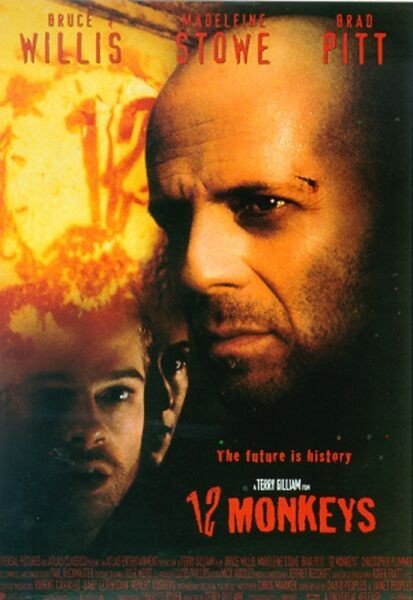
Brazil (1985, Terry Gilliam) and Twelve Monkeys (1995, Terry Gilliam) are both clever, well thought-out films that engage one emotionally and intellectually. Of the two, I prefer Brazil's allegorical vision of a dystopian retro-future because of its satirical commentary upon the powerlessness of the individual in a culture obsessed with bureaucracy and Gilliam's loving attention to humorous detail in the set design (which went on to influence the Steam punk genre). I also believe it is possible as a viewer to tell when actors have enjoyed taking part in a film and Brazil is one of those productions in which this sense comes across very strongly.
Fightclub
Both of these stories feature a protagonist fighting the state for the freedom to follow his heart, whereas Fightclub (1999, David Fincher) humorously examines the powerlessness felt by many who strive and fail to conform to social norms. For me this film is about the cognitive dissonance that can occur within a person both as a member of society and as an individual struggling to cope in the modern day with their 'cave man' brain. The cinematography in this film is interesting because the scenes mainly take place at night, the colours have been largely desaturated and the lighting is mostly subdued, giving this movie an overall feel reminiscent of exhausted insomnia – a central plot-theme.
Brief Encounter and Remains of the Day
Continuing with this theme of the individual versus conformity I have included Brief Encounter (1945, David Lean) and Remains of the Day (1993, James Ivory) as two interpretations of a very English love story which I find appealing. Both films are concerned with the internal struggle between the constraints of duty and the call of desire, both end with the protagonists having resisted the temptations with which they were presented and yet the implied conclusions of each are entirely different, accurately reflecting the eras in which they were made. In Brief Encounter, Laura is bound by her middle-class values and although she is deeply saddened at the departure of the man with whom she came so close to betraying them, we understand that the choice she has made – albeit reluctantly – is the correct one for her lasting contentment. This film was made during the chaos of the Second World War when such temptations naturally became more commonplace and divorce was still considered a scandalous state for a woman; I suspect that part of its appeal lay in the fact that many young women could relate to the painful choices Laura was presented with. In Remains of the Day, however, we are led to understand that as a younger man, James Stevens (the now ageing butler) exercised personal restraint to the point of repression and thereby not only missed out on love himself but deprived his true sweetheart (housekeeper Miss Kenton) of her rightful place in his life as his mate. Of the two films I prefer the slightly more ponderous Brief Encounter for David Lean's beautifully lit black and white cinematography and Rachmaninov’s fabulous soundtrack.
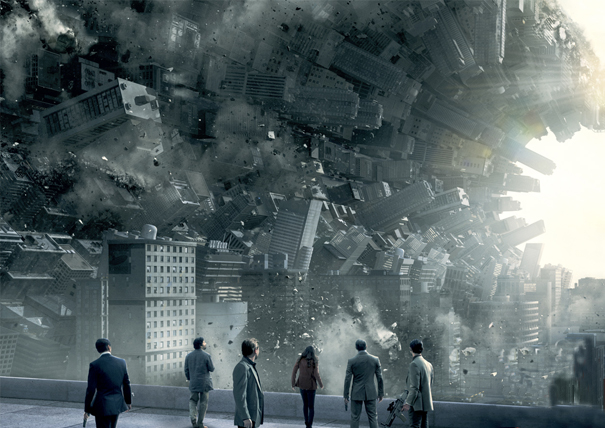
Inception
Inception (20110, Christopher Nolan) has possibly the best special effects I've seen to date and for that reason alone it has made it onto my page (although whether it will stay there in the future remains to be seen) combining miniature sets and practical effects with CGI. I feel that the many amazing dream-sequence scenes throughout the film more than compensate for a convoluted plot which at times I found as heavy-going as The Matrix trilogy.
The Company of Wolves
The Company of Wolves (1984, Neil Jordan) is a sensitive metaphor for awakening female sexuality and is probably the closest I get to liking a 'chick flick'. Whilst not the best-made movie I have seen (it looks as if it was all shot in a studio on a fairly a limited budget) it nonetheless weaves together archetypes, fairy tales and allegory to form a complex and frequently uneven narrative about the loss of innocence and dissolution of old bonds that invariably accompanies the first steps into adulthood. I do not know why this was ever billed as a horror film – there must have been a lot of disappointed audiences when it was first released.
Pulp Fiction
I have chosen Pulp Fiction (1994, Quentin Tarantino) to appear on this page for the originality of its editing and for the electrifying scenes between Uma Thurman and John Travolta. The sharp humour of the dialogue is every bit as memorable as the scenes of violence and my abiding impression of this film is that it delivers intensely in every area – colour, set design, costume, script, characterisation and plot.
It is a thoroughly entertaining movie in which the work given to the audience - to understand the actions of the larger-than-life-characters - consists less of character analysis and more of mentally reassembling the shattered elements of the film's chronology.
Photographers
Gary Winogrand
Herb Ritts
Man Ray
Henri Cartier Bresson
Annie Leibovitz
Ansel Adams
Yann Arthus-Bertrand
Diane Arbus
Walker Evans
Robert Frank
David Bailey
Gary Winogrand
Gary Winogrand has been one of my favourite photographers since I first encountered his work several years ago. I have always liked his approach - which can be summarised as 'wanting to see what the world looks like as photographs' – because it frees the photographer from the burden of having to either set shots up or hunt around for scenarios that can fulfil an internal or external brief and leaves the viewer free to draw their own conclusions about the work, bringing photography into the realms of fine art. The truth is that the world hardly ever looks anything like it does in photographs so one may as well start from that liberating premise and work outwards, in my opinion.
Herb Ritts and Man Ray
I enjoy Herb Ritts' photographs for their directness, their simplicity of composition and their sleek and sensual lines. These are beautiful, sexy images that ooze a cosmopolitan sophistication and glamour. Ritts' eye for using the human form to create abstract design is breathtaking and what I feel many of his photographs lack in emotional depth they more than make up for in aesthetic flair. In terms of both style and subject matter I think that his work has been strongly influenced by that of Man Ray (also included on this page) but whereas Ray was pursuing a wholly artistic goal of which photography comprised only one branch of expression, Ritts' work has a far more commercial appeal and meets commercial production values in ways that Ray would probably not have concerned himself with, since his interest lay more in the area of experimentation with the medium and seeing how far he could stretch different techniques.
Henri Cartier Bresson
Henri Cartier Bresson was a true master of his art and set the bar high for those who came after. The essence of his most famous work lay in his ability to 'capture the moment' - something I am currently trying to learn how to do although I doubt my reflexes will ever be as fast as his! Bresson's initial training as a painter endowed him with lifelong critical skills and as a result his work is as remarkable for its composition and framing as it is for its implicit understanding of line, form, tone and contrast.
Annie Leibovitz
Although I admire the work of Annie Leibovitz' I do not necessarily like all of it. Many of her recent tableaux have an uncomfortably frozen look as though the models were posed for too long before the shot was taken and their eyes can often lack emotional depth, but her informal portraits have a candid and immediate quality which is often very revealing.
In recorded interviews with Leibovitz that I've seen she came across as a very unaffected and natural person with no particular 'axe to grind' and I think that this is quite a large reason why she has made it on to this page. As an older, female photographer I still have to overcome a certain reticence when asking people to model or pose for me and I view Leibovitz' attitude both to her craft and to life itself as a good role model to emulate.
Ansel Adams and Yann Arthus-Bertrand
In many ways the beautiful images by Ansel Adams are opposite to those of Gary Winogrand, both in content and Adams' painstaking approach to his craft.
Adams was born at a time when photography was still a relatively novel occupation and one he was keen to see taken seriously as an art form in its own right. His subjects are almost invariably landscape and natural scenery, frequently of the vast and awe-inspiring kind. He believed strongly that sharing the unspoilt beauty of nature would offer spiritual uplift to those who saw his pictures and that by working diligently to reproduce his visualisations as photographs, others would come to share his passion for the natural world. In this respect I share his view for I am at my happiest photographing nature and all things natural.
I particularly like to see how nature reclaims things that have been abandoned by the human, de-constructing them back into their natural elements. Pollution saddens me greatly for it is an attack on what is possibly the most beautiful structure in existence. There can't be many planets as abundant as ours and to treat our home and our fellow creatures as badly as we do is ignorant, shameful and ultimately self-defeating. It is for this reason that I also love the work of Yann Arthus-Bertrand who has become famous for taking aerial photographs from the vantage point of hot air balloons. His incredible images of the Earth from above have made their way into countless posters and calendars, revealing for the first time the incredible array of life that can be seen from altitude. He is a tireless campaigner for the environment and his work has done much to raise awareness of the impact that environmental damage can have on the ecosystems of the planet.
Diane Arbus
Diane Arbus' images of people marginalised by society by their appearance, intellectual disability or lifestyle still cause controversy today. These are the people we were instructed by our mothers 'not to stare at' when we were children because it would hurt their feelings. Somehow, Arbus gained the trust of these subjects and thereby enabled us to gain a glimpse into lives that have been defined by that which cannot be disguised or hidden. Arbus herself referred to this as the gap between intention and effect and I believe that our interest in her images is still to an extent fuelled by a basic playground fear of being singled out as different in some way. Some regard these photographs as depressing and ugly, others as exploitative and politically incorrect, but I feel that it is right that images like these should cause a stir and trigger debate. They are not, ultimately about the subjects per se but about ourselves and the society we occupy.
Walker Evans and Robert Frank
The images of impoverished American share croppers produced by documentary photographer Walker Evans' for the FSA during the Great Depression are amongst the most definitive of the 20th Century. It was through studying his work for an assignment at my previous college that I learned how such photographers would set up a shot, deliberately including and excluding visual elements in order to build up a photograph that would convey an unambiguous message. The purpose of Walker's employment at that time was to facilitate changes in popular attitude toward social welfare and he succeeded in this par excellence, but he went on to extensively document the life of the common man and woman in rural America with such articulacy that he effectively set the standard for many documentary photographers to come such as Gary Winogrand (upon whom he was a major influence) and author of the 1954 book 'The Americans', Robert Frank.
Unlike Evans however, Frank used techniques such as unusual cropping and low lighting to create his messages about the disparity between the 'American Dream' and the reality faced by many in American society during the 1950's and 60's, making for an altogether different experience for the viewer. I like the idea of the bravery involved in Frank's visual decision-making and like to experiment a little with my own work along his lines to see what can be produced.
David Bailey
David Bailey is someone whose work I became used to seeing during the period that I was growing up. His startling, classic photographs of models and stars during the 1960's are amongst the most evocative of that era and he is featured on this page as an essential image-maker of the period that made the deepest visual impression on me.
My mother's brother Colin Bord was a photographer in London during the 1960's and I have happy childhood memories of travelling on the back of his green Vespa (barefoot, in a kaftan, without a helmet) during the summers of 1966/7 to Carnaby Street and Regents Park to take monochrome street life shots that we would then develop back in his darkroom (a converted mid-floor bathroom in the Maida Vale house he shared with my Grandmother).
This was the era when our current obsession with celebrity began in earnest. My elder sister used to speak of Mick Jagger, Marianne Faithfull, Twiggy, David Bailey and Jean Shrimpton ('The Shrimp') as if they lived at the other end of our tiny Yorkshire mining village and it made me feel that this fabulous banquet of exciting modern life was waiting just around the corner for me. It was a bit of a shock to arrive there as a teenager in the mid 1970's and discover that the best bits had already been eaten and most of the guests had gone home.
Spaces
Forests
Cathedrals
Abandoned buildings
Abandoned slate mines
African Plains
Mountains
Riverbanks
Mountain Pools
Deserts
Cities at Night
I have always been intensely affected by spaces, places and atmospheres. An unpleasant atmosphere or ugly surroundings have such negative effects upon me that I try to avoid spending much time in them in order to preserve my equilibrium. This is not to say that unsettling environments can't be visited – on the contrary one of my favourite photographic genres is included here is 'Abandoned Places' which are eerie by definition, but only on the basis of knowing that I can easily return to the very normality to which it provides a foil.
My surroundings are so important to my sense of wellbeing that they have often provided the decisive factor for my decisions in life – I chose to study at Glyndwr University because the atmosphere at Regent Street felt right whilst that of the other institutions I visited did not.
The environments which I find the most conducive to creativity are invariably natural ones - nature generally arranges things with a perfection that humans rarely match – which is why so many of the images here are of natural wildernesses.
Forests
Trees, woods and forests have a special meaning for me. Each little part of a forest has its own particular sense..sometimes this can feel restful and dreamlike, at other times a place may feel dark and powerful. When I was a small child, a trip to the woods with my sister was a rare and exciting treat. The walk there was long and involved crossing several roads and fields. The noise of civilisation would eventually fall away, a line of deep green would appear in the dip at the end of the sloping field we were crossing and as we grew closer and the trees rose up, the rich cool scent of the woods welcomed us in. Once inside it was like entering a different world of dappled yellow-green light where fragile flowers and ferns grew amongst the moss and shadows. One could follow the sound of water to find the stream, sit to picnic in a glade or gather fragrant bluebells. I was always sad to leave.
Cathedrals
The ribbed vaults of Gothic cathedrals – another favourite space of mine – remind me of the canopied branches in a forest and perhaps this is one of the reasons I feel so at home in them. I love ancient buildings and spent many happy hours as a teenager exploring Canterbury Cathedral. My favourite part was the peaceful crypt where the carved pillars are topped with fierce little Gothic beasts, stone eyes boggling and claws outstretched. I expect they were once painted in bright colours. Edward the Black Prince wanted to be interred down there, in the presence of the shrine to Our Lady but instead was buried above where the curious – myself included – could come and gawp at his splendid shrine. You can even see the ancient stone steps – worn down by the feet of pilgrims – where St Thomas a Beckett met his end. Old buildings, old stone..they hold something of the human who passes through them and tell the story to any who will listen.
Abandoned Buildings and Slate Mines
The powerful stories told by Abandoned Places are poignant at best and downright unnerving at worst. If a place has been generally happy - such as an empty family home or a fairground might have been - then one can experience a sadness at the absence of its people, but if it has been a place of harshness and brutality the atmosphere can be dark and frightening. The discarded relics of human occupancy – boots, chairs, numbered lockers - take on new and powerful meanings once bereft of function.
When I was 18 I shared a student house in Gillingham and we spent many evenings exploring the network of abandoned tunnels and forts dating from the Napoleonic wars that ran beneath the hillside behind our road. These places lay on MOD land and entrance to them was concealed and difficult, but we always found a way through. Inside these lightless labyrinths we found all manner of chambers, pits sunk into the centre of tunnel floors into which unwary invaders would fall and even piles of musket balls. I would love to return there and photograph this now, but Google Maps shows that this area has been built over.
The abandoned slate mines of Blaenau Ffestiniog have similarly fascinated me since I moved there in 1982. Many of the tunnel entrances have caved in since I first explored them but the overground ruins from the industry still pack a visual punch and I photograph them whenever I have the opportunity.
African Plains, Mountains, Rivers and Pools
The first time I ever saw mountains was in Africa when I visited my father there as a child and I felt an instant sense of connection with them. I chose the picture of the Kenyan veldt from the internet to include here because it is exactly as I remember it aged 9 and travelling from Nairobi to Kisumu for the first time – the land in this picture is still green from the rains a few weeks before.
Spending several summers in Malawi as a teenager, I was fortunate enough to see some of the most beautiful and breathtaking sights in Africa and they left an indelible impression upon me.
One of the reasons I love the Welsh landscape so much is because the mountains are as old and worn down as those in Africa and I felt that same sense of homecoming when I first saw them. Mountains are my landscape of choice. They are like a still life on a massive scale and I have spent many years painting and photographing them. Simply observing the light and cloud move over them is profoundly soothing. Blaenau Ffestiniog - where I have made my home for the last 30 years - sits in a kind of mountain bowl which gives it a strange, fortress-like feeling of being cut off from the rest of the world. It also causes it to be the second wettest place in Britain, which - aside from the obvious disadvantages - means that vast amounts of water tumble down the mountainsides to fill the peat bogs and lakes which in turn feed the rivers, streams, waterfalls and pools. Each of these watercourses have particular moods and ecosystems which alter as one travels downstream. Bathing in their icy waters is an incredible experience that leaves one feeling deeply connected with the land and I can happily spend all day following the path of a stream or a river, camera in hand.
Deserts
The only landscape featured on this page that I have not yet seen for myself is the desert. This is something that I feel a great desire to visit one day – there is something about the ever-shifting sculptural sandscape of dunes that calls to both the explorer and the artist in me and I have included an image of one here because of this.
Cities at Night
My final image on this page relates to the atmosphere of cities at night. This feeling can range from thrill and excitement in a city-centre to the downright frightening in areas of high crime. When I lived in London I purposely took on door-to-door canvassing work that would allow me to work during the evenings so that I could explore at night and enjoy these different flavours. It's difficult to put into words why I love to be in these settings after dark. Part of the appeal lies in the fact that fewer people are around and one is less visible which accords more leisure to stop and absorb things. I like the sense that most people are safe at home in their warm houses and that the busy stressful noises of life are becoming stilled. Everything changes in the dark, things of the day lose their meaning and a brightly lit shop window that enticed customers in only an hour before takes on a garish, hollow feel. Coloured lights become things of wonder that transform the streetscape into a new and unknown place.
Unaware that it was possible without specialist equipment, I only tried night photography for the first time very recently, but what excited me was the fact that the resulting pictures managed to convey the atmosphere that I was feeling at the time I took them. This is not something that I achieve very often and I hope to take my forays into night photography further.
Music Producers
Juan Atkins
Derrick May
Kevin Saunderson
Underground Resistance
Carl Craig
Richie Hawtin
Theo Parrish
DJ Shadow
Surgeon
Gerard Hansen
Anders Ilar
High Contrast
DJ Marky
Netsky
Pepe Braddock
Synkro
As a synaesthetic listener, I choose a lot of music on the basis of the colours, shapes, patterns and sensations experienced when I listen to it. Electronic music creates the cleanest and brightest of these for me so it is fairly natural that I would gravitate to composers who work with computers rather than guitars and keyboards (where the harmonics often clash uncomfortably). The images on this page therefore show the faces of some of the producers of electronic music who have most strongly influenced me both as an artist and a musician over the past two decades.
Techno
Juan Atkins, Derrick May, Kevin Saunderson and Underground Resistance
During the mid 1980's, three Michigan schoolfriends – Juan Atkins, Derrick May and Kevin Saunderson (all featured on this page) began combining European electronic music with restrained analogue synth lines, drum machine patterns and lush soul vocals. Together they created the uniquely funky, riff-driven sound that became known as the first wave of Detroit Techno. During the second wave (in the late 1980's) the politicized 'Underground Resistance' label was born. Often abbreviated to 'UR', this collective of skilled and innovative producers was responsible for some of the most original and influential music of the 1990's, infusing their work with aesthetics such as afrofuturism and 'technological spirituality'.
Their track 'Transition' was my mantra when I first decided to return to education!
You can listen to Underground Resistance’s 'Transition' here:
Carl Craig
Carl Craig (aka Paperclip People, BFC, Designer Music, Psyche, 69 and Innerzone Orchestra) is one of the most original producers to come out of the 'second wave' of the Detroit Techno movement and whilst his live DJ sets can sometimes lack finesse, his remixes and collaborations with fellow producers have a startling assurance that puts them amongst my favourite tracks of all time, infusing jazz and world music with his deep, trademark basses.
You can listen to Carl Craig's 'Sandstorm' here:
Richie Hawtin
Another 'second wave' producer Richie Hawtin (aka Plastikman) is a British DJ whose constant innovations in the field of progressive and minimal techno – a sub-genre first produced by UR member Robert Hood - have proved highly influential in the German techno scene. I enjoy minimal techno for its stripped-down lines, predominantly dry production values and elegant sense of understatement. Listening to Hawtin's music is like travelling long distances in a smooth, state-of-the-art car and leaves one feeling calm and refreshed.
You can listen to Richie Hawtin's 'DE 9 Transitions' here:
Theo Parrish
Theo Parrish is a trained sonic artist whose interest in old disco, funk and soul allows him to explore vintage influences to create new and cutting-edge tracks. This approach together with his refusal to become pigeon-holed means that his work retains a fresh, contemporary feel and his work is always infused with a kind of polished energy.
You can listen to Theo Parrish's 'Lost Keys' here:
DJ Shadow
Using nothing but a pair of of turntables, a 12bit Akai drum sampler and a rudimentary copy of Pro-Tools, DJ Shadow (Joshua Paul Davis) was one of the first producers to employ cut-and-paste sequencing and he can accurately be described as the originator of trip hop. His first album 'Endtroducing' released in 1996 was the result of intensive crate digging and the very first album to be created entirely from sampled loops. I have found his subsequent albums a little too dark for my taste, but Entroducing remains high on my list of favourite albums of all time, evoking strange melodic textures and a sense of fractured reality.
You can listen to DJ Shadow's 'Stem – Long Stem' here:
Surgeon
Surgeon (Anthony Childs) is a British DJ and electronic music producer whose work defies precise categorisation, although much of it could be accurately described as European techno due to his use of lengthy percussive loops in which barely perceptible changes gradually occur over the course of several minutes. I find his music energising and regulating and it has provided the background music for many of my visual projects.
You can listen to Surgeon's 'The Crawling Frog' here:
Gerard Hansen
Gerard Hansen (aka E.R.P., Convextion) is a Texan producer with Scandinavian roots. He has been strongly influenced by the work of Juan Atkins, Derrick May, Carl Craig, minimal techno and Berlin techno. His haunting melodic textures are highly evocative of the kind of night scenes and abandoned places that I love to photograph, which is perhaps one of the reasons I enjoy his work so much. I find however that it is necessary to be in the right frame of mind to listen to it otherwise it can cause feelings of depression.
You can listen to Convextion's 'Faktion II' here:
Anders Ilar
Anders Ilar is a Swedish producer of ambient and acid techno. His delicate, empty soundscapes are amongst my favourite pieces of electronic music and employ a restrained and pared-down aesthetic. His tracks appeal to to the same part of me as Hansen's work, but Ilar's writing seems to evoke the cold science underlying the natural world rather than the soulless emptiness of the human one. Listening to his music I see snowflakes, crystals and the heartless stars turning in their orbits.
You can listen to Anders Ilar's 'Flakes Descent' here:
Drum and Bass
High Contrast
High Contrast (Lincoln Barrett) and DJ Marky (Marco Antonio Silva) are DJs and producers who are at the very top of their game. DnB is a wholly British and constantly evolving musical phenomena that grew out of the rave scene during the late 1980's and early 90's. It is characterised by fast breakbeats over a powerful bass line (and more recently a sub bass). High Contrast is from Wales (his father used to manage 'Shakin Stevens') and his primary influences were from the soundtracks of films rather than the music scene. His music can be described as simultaneously melancholic and uplifting.
I have always loved pure DnB for its power to warm and energise me when I am flagging. Recent innovations in the genre however have not been to my liking, and I have included these two DJs because they have remained true to the original spirit of the genre and produced intelligent music whilst still pushing production values upwards.
You can listen to High Contrast's 'If We Ever' here:
DJ Marky
DJ Marky is Brazilian born and began his career playing UK Drum and Bass in the clubs of Sao Paolo before being discovered in 1998 by the head of V Recordings who brought him to play in London where his career subsequently took off. Marky has an entirely original take on Drum and Bass – one from which he has never departed – and his music is infused with a joyful and carefree energy that speaks of heat and sunshine.
You can listen to DJ Marky's 'Yellow Shoes' here:
Netsky
Netsky (Boris Daenen) is a Belgian producer famous for the liquid funk style of DnB which features lush synths and strings overlaid with rich vocal samples. He has been strongly influenced by High Contrast and his joyful, energetic music reflects this. He is an artist that I listening to frequently for a boost of adrenaline.
You can listen to Netsky's 'Iron Heart' here:
House
Pépé Braddock
Pépé Bradock (Julien Auger) is a French remixer, DJ and producer whose influences range from dub and reggae to house and techno. Whilst I enjoy the versatility of his live sets, his place on my influence board is mainly due to one particular track dating from 1999 which has a personal meaning for me, signifying a happy and optimistic time in my life.
The track in question is called 'Burning' and utilises a sample from Freddie Hubbard's 'Little Sunflower' from his 1979 album 'The Love Connection'. The result is a powerful, sophisticated track that for me is suffused with sunlight and diesel in equal measures. It is one of the best house tracks I have ever heard.
You can listen to Pepe Braddock's 'Burning' here:
T Williams
T Williams (Tesfa Williams) is an up and coming house DJ and producer who originally made his name on the garage and the grime scenes back in the mid 00's. When interest in the genre waned, Williams disappeared back into the studio to spend several years retraining himself, emerging in 2010/11 as the accomplished and house producer we see today. His music is clever, dirty, and fascinating to listen to. I would rank his recent releases amongst my favourite tracks to date and each time I listen to his work I find new things in it. Williams is a source of inspiration to me not only for the way he re-invented himself but also for the humility that enabled him to learn the ways of a new craft in order to stay current with the music that he loves.
You can listen to T William's 'Breach - Fartherless' here:
Dubstep
Synkro
Synkro (Joe McBride) is a dubstep producer from Manchester whose rich, dark textures and introspective melodies floating over deep bass riffs have propelled him to the forefront of his genre. I feel that he has done a great deal to steer an engaging middle course between the harder aspects of dubstep / UK Bass (such as that produced by Skream for example) and the overly ambient, texture-driven work of artists such as Burial. He clearly knows how to allow a track to breathe and his work effortlessly evokes the grit and rain of British suburban life.
You can listen to Synkro's 'Angels' here:
Summary
During the course of researching and writing this document I have enjoyed taking the time to revisit works of art and pieces of music which have personal meaning for me as a designer.
Looking at the images gathered, I would say that in terms of visual work my interests lean toward the illustrative and narrative and that I am happy for realism to take second place to expression. I evidently enjoy rich colours, balanced compositions, simplicity of form and continuity of line. I also clearly prefer curves and spheres to cubes and straight lines and consider the emotional content of images to be important, preferring calm scenes to those portraying drama. This would appear to run entirely opposite to my taste in films and music which explore the themes of conformity and rebellion but my interest in these stories has more to do with the idea of development and resolution rather than conflict per se.
I receive a lot of my emotional information subliminally or intuitively and when I am able to base my creative work on this the results are usually pleasing. The fact that I have selected a whole page to illustrate this (when I could equally have chosen poetry or psychology) informs me that this is an important area for my development as a visual artist and that I need to pay more attention to it in the future.
The overall feeling that I get when looking at the pages I have made is that I am interested by transition – how one element changes another and how that in turn adapts, whether that be in the movement of soundscapes, the personal development of an artist or film character or the journey made by a line on paper. Whatever the context, the transition is what arrests my gaze.
References
Image References
Paintings
Cave Paintings (2012) Lascaux [Online image]
Available from:
[Electronically Accessed 24th January 2012]
Botticelli Venus & Mars (nd) [Online image]
Available from:
[Electronically Accessed 24th January 2012]
Van Goch (nd) Night Cafe [Online image]
Available from:
[Electronically Accessed 24th January 2012]
Pablo Picasso (nd) Camel [Online image]
Available from:
[Electronically Accessed 24th January 2012]
Georges Seurat The Bathers (nd) [Online image]
Available from:
[Electronically Accessed 25thJanuary 2012]
Edouard Manet (nd) Bar at the Folies Begere [Online image]
Available from:
[Electronically Accessed 27th January 2012]
Jan Johannes Vermeer (nd) The Milkmaid [Online image]
Available from:
[Electronically Accessed 27th January 2012]
Edgar Degas (nd) Woman Drying Herself [Online image]
Available from:
http://fineartamerica.com/images-simple-print/images-medium/woman-drying-herself-edgar-degas.jpg
[Electronically Accessed 24th January 2012]
Paul Cezanne (nd) Basket of Apples [Online image]
Available from:
[Electronically Accessed 28th January 2012]
Toulouse Lautrec (nd) Salon at the Rue des Moulins [Online image]
Available from:
[Electronically Accessed 26thJanuary 2012]
Wassily Kandinsky (nd) Yellow-Red-Blue [Online image]
Available from:
[Electronically Accessed 24hJanuary 2012]
Mark Rothko (nd) Tryptich [Online image]
Available from:
http://noelpecout.blog.lemonde.fr/files/2010/05/rothkotryptich.1275163321.thumbnail.jpg
[Electronically Accessed 29thJanuary 2012]
Design Eras
Ancient Egypt
Blogspot website (2012) [Online image]
Available from:
https://blogger.googleusercontent.com/img/b/R29vZ2xl/AVvXsEhAiu2KtJPF2sVSZCPCLRwjcqF8LtZGBI9PaEdWZQrpT6nE27DisSXBs_auI7mB7IQlihge6JkI9TTKKXTW7vpM0jKY-V7bvi9KRt8tzpn-hTNR9oUY34KmQWy0NgVwGTdlJ9jNVFFAHIc/s640/owen+jones-1856-the+grammar+of+ornament-egypt+7.jpg
[Electronically Accessed 25th January 2012]
Glogster website (nd) [Online image]
Available from:
http://edu.glogster.com/media/5/21/85/47/21854702.jpg
[Electronically Accessed 25th January 2012]
Flickr website (2012) [Online image]
Available from:
http://farm4.static.flickr.com/3162/3280478323_143b626b3d.jpg?v=0
[Electronically Accessed 25th January 2012]
Jerry and Martha website (nd) [Online image]
Available from:
[Electronically Accessed 27th January 2012]
Ancient Greece
Visit Athens website (nd) [Online image]
Available from:
http://www.schjolberg.com/images/Greece,%20Athens,%20The%20Acropolis,%20The%20Karyatides%20statues%20of%20the%20Erechtheion%20%20-%20Photo%20by%20Visit%20Athens.jpg
[Electronically Accessed 25th January 2012]
Amazon website (2012) [Online image]
Available from:
http://ecx.images-amazon.com/images/I/51d-CCHC4uL._SS500_.jpg
[Electronically Accessed 29th January 2012]
Wright Photo website (2012) [Online image]
Available from:
http://www.wright-photo.com/GreeceandTurkeyImages/065Akotiri4.jpg
[Electronically Accessed 25th January 2012]
Wright Photo website (2012) [Online image]
Available from:
http://www.wright-photo.com/GreeceandTurkeyImages/064Akotiri3.jpg
[Electronically Accessed 27th January 2012]
History website (nd) [Online image]
Available from:
http://www.history.org.uk/library/1101/0000/0220/boxing_boys_ancient_greece_295.jpg
[Electronically Accessed 26th January 2012]
Medieval
Exblog website (nd) [Online image]
Available from:
http://pds.exblog.jp/pds/1/200910/19/97/b0107597_1951254.jpg
[Electronically Accessed 27th January 2012]
Karen Whimsy website (2012) [Online image]
Available from:
http://karenswhimsy.com/public-domain-images/medieval-art/images/medieval-art-1.jpg
[Electronically Accessed 26th January 2012]
Karen Whimsy website (2012) [Online image]
Available from:
http://karenswhimsy.com/public-domain-images/medieval-art/images/medieval-art-7.jpg
[Electronically Accessed 28th January 2012]
Esotcelt website (nd) [Online image]
Available from:
http://esotcelt.unblog.fr/files/2006/11/3damelalicornewww.neomillenium.org.jpg
[Electronically Accessed 28th January 2012]
Tudor
Woodlands website (2011) [Online image]
Available from:
http://www.woodlands-junior.kent.sch.uk/homework/houses/tudors/new/pand.jpg
[Electronically Accessed 27th January 2012]
Gstatic website (nd) [Online image]
Available from:
http://t0.gstatic.com/images?q=tbn:ANd9GcSRx7XoLtPzZ9sigXPz6A16v7Lzphk2EYqvr89JS4_1SEo0HKoqzA
[Electronically Accessed 28th January 2012]
Mac website (2012) [Online image]
Available from:
http://homepage.mac.com/xcia0069/Review/holbein-more.jpg?w=300&h=300
[Electronically Accessed 28th January 2012]
Shafe website (nd) [Online image]
Available from:
http://www.shafe.co.uk/crystal/images/lshafe/Anon_Elizabeth_I_Rainbow_Portrait_c1600.jpg
[Electronically Accessed 28th January 2012]
Blogspot website (2012) [Online image]
Available from:
https://blogger.googleusercontent.com/img/b/R29vZ2xl/AVvXsEgPUa5qk3cr9asvO396U2T6EMAOU-EzkDEZL4GnSXtL26m95RVtzLD7GgDlEuYlK0l9WsgTm9WHWmBmF3UyGOLMAcA5XNZNC63YtTgrqegU13um3fuWqqvwmaMYdDLZSeIOoYcWRWH4IpE0/s660/Great+Bed+Of+Ware.jpg
[Electronically Accessed 29th January 2012]
Art Nouveau
Onnellinen website (nd) [Online image]
Available from:
http://onnellinen.files.wordpress.com/2009/05/victorhortastaircase.jpg
[Electronically Accessed 27th January 2012]
L'artnouveau website (2012) [Online image]
Available from:
http://lartnouveauenfrance.files.wordpress.com/2011/03/frc3a8res-muller-vase-1606-07.jpg?w=222&h=300
[Electronically Accessed 28th January 2012]
Imageshack website (2012) [Online image]
Available from:
http://img529.imageshack.us/img529/7707/alphonsemucha35.jpg
[Electronically Accessed 26th January 2012]
Wooster Collective website (nd) [Online image]
Available from:
http://www.woostercollective.com/Aubrey_Beardsley_1894_Salome.jpg
[Electronically Accessed 28th January 2012]
Identifont website (2012) [Online image]
Available from:
http://www.identifont.com/samples/bannigan/ArtNouveau.gif
[Electronically Accessed 28th January 2012]
Art Deco
Identifont website (2012) [Online image]
Available from:
http://www.identifont.com/samples/nicksfonts/BoogalooBoulevard.gif
[Electronically Accessed 27th January 2012]
Collectables blog website (nd) [Online image]
Available from:
http://blog.collectables-now.com/wp-content/uploads/2007/12/art-deco.jpg
[Electronically Accessed 28th January 2012]
Live Journal website (nd) [Online image]
Available from:
http://pics.livejournal.com/renatr/pic/001ycz4g
[Electronically Accessed 27th January 2012]
Flickr website (2012) [Online image]
Available from:
http://farm3.static.flickr.com/2191/2229373604_653ebde251.jpg
[Electronically Accessed 28th January 2012]
Simply Quirky website (nd) [Online image]
Available from:
http://www.simplyquirky.co.uk/acatalog/201071-01-large.jpg
[Electronically Accessed 29th January 2012]
1950's
Model Bus Federation website (nd) [Online image]
Available from:
http://www.model-bus-federation.org.uk/journal/mbj425sep06/425-0401.jpg
[Electronically Accessed 27th January 2012]
Blogspot website (2012) [Online image]
Available from:
https://blogger.googleusercontent.com/img/b/R29vZ2xl/AVvXsEjWy8bCmlzYaIJJ0AnDbuqwz5Hq81tLhoSOJ2Ip9TrAm3SASbzp939n1Z3mHk_V7gdTA9f3ZsZ0bYFj7__NqJshCWMFFF_4OuqqF8cipX1u3mwAtFvKaWAvXAyR1phR1NdGAM1p1oifJuPY/s320/Sanderson+Mobiles+blue.jpg
[Electronically Accessed 27th January 2012]
Interior Design website (nd) [Online image]
Available from:
http://79.170.245.208/student_support/interior_design/may_jun09/exhibitions_and_events/Moda%201950s%20Design.jpg
[Electronically Accessed 27th January 2012]
Cookit website (nd) [Online image]
Available from:
http://cookit.e2bn.org/library/1237526194/kitchen1.original.jpg
[Electronically Accessed 28th January 2012]
Blogspot website (2012) [Online image]
Available from:
https://blogger.googleusercontent.com/img/b/R29vZ2xl/AVvXsEiTtfwC3OUL277gyZx5Y43xwKEQcnH2NfX2QQZPUjdtoxCyFLOH8n-7QQOqMadYzuRB0Yj8M7N9rQsyL9B6X02bJkQZMFlBlut08Nta2jSdsdL4TUHivKZprpCj6vGQw_hyphenhyphenG5mikBMvVnU/s200/Image13.jpg
[Electronically Accessed 29th January 2012]
Home Sweet Home website (nd) [Online image]
Available from:
http://www.homesweethomestyle.co.uk/images/products/April%20%20new%202%20007.jpg
[Electronically Accessed 24th January 2012]
La Tene Culture
Flickr website (2012) [Online image]
Available from:
http://farm3.static.flickr.com/2599/3762149832_393b91ed24.jpg
[Electronically Accessed 28th January 2012]
Flickr website (2012) [Online image]
Available from:
[Electronically Accessed 26th January 2012]
Art imagery website (nd) [Online image]
Available from:
http://www.art-imagery.com/images/kells_177r_B.jpg
[Electronically Accessed 26th January 2012]
Mac website (2012) [Online image]
Available from:
http://homepage.mac.com/mseffie/assignments/beowulf/book%20of%20kells/kell2.gif
[Electronically Accessed 25th January 2012]
Extraordinary Books website (2012) [Online image]
Available from:
http://extraordinarybookofdoors.com/images/bm%20picture%20034d.jpg
[Electronically Accessed 25th January 2012]
Extraordinary Books website (2012) [Online image]
Available from:
[Electronically Accessed 25th January 2012]
Film
Very CD website (nd) Twelve Monkeys Movie Poster [Online image]
Available from:
[Electronically Accessed 21st January 2012]
Rathaus Art Projects website (2012) Twelve Monkeys Movie Still [Online image]
Available from:
http://rathausartprojects.com/blog/wp-content/uploads/2009/01/12_monkeys.jpg
[Electronically Accessed 21st January 2012]
Imageshack website (2012) Brazil Movie Poster [Online image]
Available from:
[Electronically Accessed 21st January 2012]
Architecture website (nd) Brazil Movie Still [Online image]
Available from:
http://www.architecture.uwaterloo.ca/faculty_projects/terri/film_08/brazil48.jpg
[Electronically Accessed 21st January 2012]
Wallpapers website (2012) The Godfather Movie Poster [Online image]
Available from:
http://wallpaperforgames.com/wp-content/uploads/2011/12/16/the-godfather-1-1024www-mywallpapers-com-1024x768.jpg
[Electronically Accessed 21st January 2012]
Film Frame website (nd) The Godfather Movie Still [Online image]
Available from:
[Electronically Accessed 21st January 2012]
Collider website (nd) Inception Movie Poster [Online image]
Available from:
[Electronically Accessed 26th January 2012]
Yanko Design website (2012) Inception Movie Still [Online image]
Available from:
[Electronically Accessed 26th January 2012]
IMDB website Fightclub (2012) Movie Poster [Online image]
Available from:
http://ia.media-imdb.com/images/M/MV5BMTc1ODg1NTMxNV5BMl5BanBnXkFtZTYwOTg4Njk4._V1._SY317_CR4,0,214,317_.jpg
[Electronically Accessed 26th January 2012]
IMDB website Fightclub (2012) Movie Still [Online image]
Available from:
http://www.imdb.com/media/rm334662912/tt0137523
[Electronically Accessed 26th January 2012]
IMDB website (2012) Carlito's Way Movie Poster [Online image]
Available from:
http://ia.media-imdb.com/images/M/MV5BNjU1OTE5NDIyNl5BMl5BanBnXkFtZTYwMjg1NDg4._V1._SY317_.jpg
[Electronically Accessed 27th January 2012]
Blogspot website Carlito's Way (2012) Movie Still [Online image]
Available from:
https://blogger.googleusercontent.com/img/b/R29vZ2xl/AVvXsEhywvt7C5vPdomCq-RgVd16pJ0e_ZuFdFfJ67Wuvon4ULrnEsn41Y6LM9nuYFByzBOrmRWo9h5qO0leIG-UwVFO1NDSYtGJI5Olw3VB5pEUlxVd-KHjLgaq_rHN2rUJqbqm8X2K63LOhmE/s1600/carlito2.jpg
[Electronically Accessed 27th January 2012]
Carlito's Way (nd) Movie Still [Online image]
Available from:
http://www.dvdbeaver.com/film3/blu-ray_reviews51/carlitos_way_blu-ray/large/large_carlitos_way_blu-ray1x.jpg
[Electronically Accessed 27th January 2012]
IMDB website The Company of Wolves (2012) Movie Poster [Online image]
Available from:
[Electronically Accessed 27th January 2012]
The Company of Wolves (2012) Movie Still [Online image]
Available from:
http://www.moviecritic.com.au/images/thecompanyofwolvesjordan19841.jpg
[Electronically Accessed 26th January 2012]
IMDB website Pulp Fiction (2012) Movie Poster [Online image]
Available from:
http://ia.media-imdb.com/images/M/MV5BMjE0ODk2NjczOV5BMl5BanBnXkFtZTYwNDQ0NDg4._V1._SY317_CR4,0,214,317_.jpg
[Electronically Accessed 27th January 2012]
IMDB website Pulp Fiction(2012) Movie Still [Online image]
Available from:
http://www.imdb.com/media/rm597602304/tt0110912
[Electronically Accessed 26th January 2012]
Brief Encounter (2012) Movie Poster [Online image]
Available from:
http://upload.wikimedia.org/wikipedia/en/thumb/3/3a/BriefEncounterPoster.jpg/220px-BriefEncounterPoster.jpg
[Electronically Accessed January 28th 2012]
Brief Encounter Movie Still (nd) [Online image]
Available from:
http://www.ferdyonfilms.com/wp-content/uploads/2010/03/BriefEncounter_w.jpg
[Electronically Accessed 27th January 2012]
IMDB website (2012) Scarface Movie Poster [Online image]
Available from:
[Electronically Accessed 26th January 2012]
IMDB website (2012) Scarface Movie Still [Online image]
Available from:
http://www.imdb.com/media/rm3854151680/tt0086250
[Electronically Accessed 26th January 2012]
IMDB website (2012) The Remains of the Day Movie Poster [Online image]
Available from:
http://ia.media-imdb.com/images/M/MV5BMTM2NzIwMTM5NV5BMl5BanBnXkFtZTcwNjQ2MTYyMQ@@._V1._SY317_.jpg
[Electronically Accessed 27th January 2012]
The Remains of the Day (2012) Movie Still [Online image]
Available from:
http://thebestpictureproject.files.wordpress.com/2011/01/theremainsoftheday3.jpg
[Electronically Accessed 27th January 2012]
Photographers
Blogspot website (nd) Gary Winogrand [Online image]
Available from:
https://blogger.googleusercontent.com/img/b/R29vZ2xl/AVvXsEjS4N3EQjm-JubXcO7qfQAFkJ4HA8aRhr9dSAiqFUbFMX8Dk3YBhVKOIZNED8LRB0k05vD-ZpEQVHKyoMKnmUV1FtuDxwgTK8dBMiSUce3P4_m8YTgGPME42_vJn_KfJw75QbffncjJyRLh/s1600/Winogrand+5.jpg
[Electronically Accessed 23rd January 2012]
Spottr website Gary Winogrand (nd) World's Fair [Online image]
Available from:
http://spottr.hu/wp-content/uploads/2010/12/winogrand_worlds_fair.jpg
[Electronically Accessed 23rd January 2012]
Opednews website (2012) Herb Ritts [Online image]
Available from:
http://www.opednews.com/populum/uploaded/a-herb-ritts-19172-20091010-353.jpg
[Electronically Accessed 25th January 2012]
Blogspot website Herb Ritts (nd) Madonna [Online image]
Available from:
http://3.bp.blogspot.com/-Ln1qo5wZGkY/TVokrclEoQI/AAAAAAAAALs/ltG4p1sHdGU/s1600/herb-ritts-008.jpg
[Electronically Accessed 25th January 2012]
Gorod website (2011) Henri Cartier Bresson [Online image]
Available from:
http://gorod.tomsk.ru/i/u/367/h_cartier_bresson_magnum.jpg
[Electronically Accessed 25th January 2012]
Blogspot website (nd) Henri Cartier Bresson Man's Shadow, Girl Leaning [Online image]
Available from:
https://blogger.googleusercontent.com/img/b/R29vZ2xl/AVvXsEgPHX4GxxHMPNYosxtNoaSySm_PvPSGI78-JxHGcwAeviEyY_N3WYT-uq9oGM8f9Jg6NgsoELP-8blYmrD8R8kWwruPTBrJsxRJUshSoehW4nf6mgbWBNzGI8BzNzemc3yQI253k-wlrBI/s1600/henri-cartier-bresson-mexico-1964-mans-shadow-girl-leaning.jpg
[Electronically Accessed 27th January 2012]
Indyposted website (nd) Annie Leibovitz [Online image]
Available from:
http://indyposted.com/wp-content/uploads/2010/04/Annie-Leibovitz-768x1024.jpg
[Electronically Accessed 27th January 2012]
Flickr website (2012) Annie Leibovitz Mick Jagger [Online image]
Available from:
http://farm6.static.flickr.com/5286/5248251403_de6e3201fa_o.jpg
[Electronically Accessed 27th January 2012]
Google website (2012) Ansel Adams [Online image]
Available from:
http://lh4.google.com/lilaliss/R94SlxUi88I/AAAAAAAAEKs/HDllKVaKHho/AD001443.jpg
[Electronically Accessed 28th January 2012]
Daily Art Fix website (nd) Ansel Adams Jeffrey Pine Sentinel [Online image]
Available from:
[Electronically Accessed 28th January 2012]
Answers website (2012) Diane Arbus [Online image]
Available from:
[Electronically Accessed 28th January 2012]
Metro website Diane Arbus (nd) Identical Twins, Roselle, 1967 [Online image]
Available from:
http://img.metro.co.uk/i/pix/2009/05/arbus_450x300.jpg
[Electronically Accessed 28th January 2012]
Yo Jo website (nd) Man Ray [Online image]
Available from:
http://yojo.ru/wp/wp-content/uploads/2011/01/Man_Ray_1934.jpg
[Electronically Accessed 28th January 2012]
Imageshack website (2012) Man Ray Violon [Online image]
Available from:
http://img142.imageshack.us/img142/7751/manray2ml4.jpg
[Electronically Accessed 26th January 2012]
Chamblee website (nd) Walker Evans [Online image]
Available from:
http://chamblee54.files.wordpress.com/2011/02/8a14702x.jpg?w=720&h=447
[Electronically Accessed 26th January 2012]
Xroads website (nd) Walker Evans Fields Family [Online image]
Available from:
http://xroads.virginia.edu/~ug97/fsa/evanspegs/evans19.jpg
[Electronically Accessed 26th January 2012]
Blogspot website (2012) Robert Frank [Online image]
Available from:
[Electronically Accessed 26th January 2012]
Nicholas Spyer website (nd) Robert Frank Trolley, New Orleans [Online image]
Available from:
http://nicholasspyer.files.wordpress.com/2010/09/18_robert-frank_trolley-new-orleans_1955.jpg
[Electronically Accessed 26th January 2012]
Media Bistro website (nd) David Bailey [Online image]
Available from:
http://www.mediabistro.com/unbeige/original/d_bailey.jpg
[Electronically Accessed 28th January 2012]
Listverse Website (nd) David Bailey Krays [Online image]
Available from:
http://listverse.files.wordpress.com/2010/02/prisons-krays-tm.jpg?w=370&h=347
[Electronically Accessed 28th January 2012]
Portal website (nd) Yann Arthus [Online image]
Available from:
http://portal.unesco.org/en/files/46949/12592322751YAB.jpg/YAB.jpg
[Electronically Accessed 28th January 2012]
Wallpapers website (2012) Yann Arthus Image from 'Earth from Above' [Online image]
Available from:
http://www.wallpapersphotography.com/yann-arthus-bertrand/images/yann_arthus-bertrand_photos__149.jpg
[Electronically Accessed 28th January 2012]
Spaces
Photobucket website (2011) Canehill Mental Asylum, London [Online image]
Available from:
http://img.photobucket.com/albums/v72/mechanised/canehill/desk3102a.jpg
[Electronically Accessed 21st January 2012]
Uncoached website(nd) Beautiful Forest [Online image]
Available from:
[Electronically Accessed 2012]
Tourist Stamps website (nd) Canterbury Cathedral [Online image]
Available from:
http://touriststamps.co.uk/Attraction_photos/Canterbury-Cathedral.jpg
[Electronically Accessed 21st January 2012]
Namibian website (nd) Namibian Dunes [Online image]
Available from:
http://www.namibian.org/travel/lodging/pictures/little_kulala/fullsize/Desert_Dunes_fs.jpg
[Electronically Accessed 21st January 2012]
Blogspot website (nd) Masai Mara [Online image]
Available from:
https://blogger.googleusercontent.com/img/b/R29vZ2xl/AVvXsEiBxf3X3RZGuvuqhXqlmDnSmDrQOWEOwZ6-7WH3T8OSeZwsMw87qvNoF8ZALao2AGwo2WWyE14m_eXhKdxk__jemBRHc0bpnBaSzuw4CRtKHAquR1OuXrAlKiN3r8nRc39B2J_pBrblt92J/s1600/Masai+Mara+123.jpg
[Electronically Accessed 23rd January 2012]
Blogspot website (nd) Gary Winogrand [Online image]
Available from:
https://blogger.googleusercontent.com/img/b/R29vZ2xl/AVvXsEjS4N3EQjm-JubXcO7qfQAFkJ4HA8aRhr9dSAiqFUbFMX8Dk3YBhVKOIZNED8LRB0k05vD-ZpEQVHKyoMKnmUV1FtuDxwgTK8dBMiSUce3P4_m8YTgGPME42_vJn_KfJw75QbffncjJyRLh/s1600/Winogrand+5.jpg
[Electronically Accessed 23rd January 2012]
Spottr website Gary Winogrand (nd) World's Fair [Online image]
Available from:
http://spottr.hu/wp-content/uploads/2010/12/winogrand_worlds_fair.jpg
[Electronically Accessed 23rd January 2012]
Opednews website (2012) Herb Ritts [Online image]
Available from:
http://www.opednews.com/populum/uploaded/a-herb-ritts-19172-20091010-353.jpg
[Electronically Accessed 25th January 2012]
Blogspot website Herb Ritts (nd) Madonna [Online image]
Available from:
http://3.bp.blogspot.com/-Ln1qo5wZGkY/TVokrclEoQI/AAAAAAAAALs/ltG4p1sHdGU/s1600/herb-ritts-008.jpg
[Electronically Accessed 25th January 2012]
Gorod website (2011) Henri Cartier Bresson [Online image]
Available from:
http://gorod.tomsk.ru/i/u/367/h_cartier_bresson_magnum.jpg
[Electronically Accessed 25th January 2012]
Blogspot website (nd) Henri Cartier Bresson Man's Shadow, Girl Leaning [Online image]
Available from:
https://blogger.googleusercontent.com/img/b/R29vZ2xl/AVvXsEgPHX4GxxHMPNYosxtNoaSySm_PvPSGI78-JxHGcwAeviEyY_N3WYT-uq9oGM8f9Jg6NgsoELP-8blYmrD8R8kWwruPTBrJsxRJUshSoehW4nf6mgbWBNzGI8BzNzemc3yQI253k-wlrBI/s1600/henri-cartier-bresson-mexico-1964-mans-shadow-girl-leaning.jpg
[Electronically Accessed 27th January 2012]
Indyposted website (nd) Annie Leibovitz [Online image]
Available from:
http://indyposted.com/wp-content/uploads/2010/04/Annie-Leibovitz-768x1024.jpg
[Electronically Accessed 27th January 2012]
Flickr website (2012) Annie Leibovitz Mick Jagger [Online image]
Available from:
http://farm6.static.flickr.com/5286/5248251403_de6e3201fa_o.jpg
[Electronically Accessed 27th January 2012]
Google website (2012) Ansel Adams [Online image]
Available from:
http://lh4.google.com/lilaliss/R94SlxUi88I/AAAAAAAAEKs/HDllKVaKHho/AD001443.jpg
[Electronically Accessed 28th January 2012]
Daily Art Fix website (nd) Ansel Adams Jeffrey Pine Sentinel [Online image]
Available from:
Answers website (2012) Diane Arbus [Online image]
Available from:
[Electronically Accessed 28th January 2012]
Metro website Diane Arbus (nd) Identical Twins, Roselle, 1967 [Online image]
Available from:
http://img.metro.co.uk/i/pix/2009/05/arbus_450x300.jpg
[Electronically Accessed 28th January 2012]
Yo Jo website (nd) Man Ray [Online image]
Available from:
http://yojo.ru/wp/wp-content/uploads/2011/01/Man_Ray_1934.jpg
[Electronically Accessed 28th January 2012]
Imageshack website (2012) Man Ray Violon [Online image]
Available from:
http://img142.imageshack.us/img142/7751/manray2ml4.jpg
[Electronically Accessed 26th January 2012]
Chamblee website (nd) Walker Evans [Online image]
Available from:
http://chamblee54.files.wordpress.com/2011/02/8a14702x.jpg?w=720&h=447
[Electronically Accessed 26th January 2012]
Xroads website (nd) Walker Evans Fields Family [Online image]
Available from:
http://xroads.virginia.edu/~ug97/fsa/evanspegs/evans19.jpg
[Electronically Accessed 26th January 2012]
Blogspot website (2012) Robert Frank [Online image]
Available from:
[Electronically Accessed 26th January 2012]
Nicholas Spyer website (nd) Robert Frank Trolley, New Orleans [Online image]
Available from:
http://nicholasspyer.files.wordpress.com/2010/09/18_robert-frank_trolley-new-orleans_1955.jpg
[Electronically Accessed 26th January 2012]
Media Bistro website (nd) David Bailey [Online image]
Available from:
http://www.mediabistro.com/unbeige/original/d_bailey.jpg
[Electronically Accessed 28th January 2012]
Listverse Website (nd) David Bailey Krays [Online image]
Available from:
http://listverse.files.wordpress.com/2010/02/prisons-krays-tm.jpg?w=370&h=347
[Electronically Accessed 28th January 2012]
Portal website (nd) Yann Arthus [Online image]
Available from:
http://portal.unesco.org/en/files/46949/12592322751YAB.jpg/YAB.jpg
[Electronically Accessed 28th January 2012]
Wallpapers website (2012) Yann Arthus Image from 'Earth from Above' [Online image]
Available from:
http://www.wallpapersphotography.com/yann-arthus-bertrand/images/yann_arthus-bertrand_photos__149.jpg
[Electronically Accessed 28th January 2012]
Music Producers
Fabric London website (2012) Carl Craig [Online image]
Available from:
[Electronically Accessed 24thJanuary 2012]
Blogspot website (2009)Convextion [Online image]
Available from:
[Electronically Accessed 29thJanuary 2012]
Don't Panic Online website (nd) DJ Shadow [Online image]
Available from:
[Electronically Accessed 29th January 2012]
New Assets website (2012) Surgeon [Online image]
Available from:
[Electronically Accessed 29thJanuary 2012]
Details of my life (2012) High Contrast [Online image]
Available from:
[Electronically Accessed 24thJanuary 2012]
Blogspot website (2011) DJ Marky [Online image]
Available from:
[Electronically Accessed 24thJanuary 2012]
Factmag website (2009) Theo Parrish [Online image]
Available from:
[Electronically Accessed 2012]
Resident Advisor website (2012) T Williams [Online image]
Available from:
[Electronically Accessed 28thJanuary 2012]
Sounds Good to me Too website (2011) Netsky [Online image]
Available from:
http://soundsgoodtometoo.com/wp-content/uploads/2011/06/netsky.jpg
[Electronically Accessed 28thJanuary 2012]
Underground Resistance website (2012) Underground Resistance [Online image]
Available from:
http://www.undergroundresistance.com/
[Electronically Accessed 28thJanuary 2012]
Soundscaping website (2010) Cover of 'The Brazillian Job' [Online image]
Available from:
[Electronically Accessed 28thJanuary 2012]
Resident Advisor website (2012) Richie Hawtin [Online image]
Available from:
http://www.residentadvisor.net/images/features/richie-hawtin-1.jpg
[Electronically Accessed 23rd January 2012]
Blogspot website (2010) Juan Atkins [Online image]
Available from:
https://blogger.googleusercontent.com/img/b/R29vZ2xl/AVvXsEgI7GLRS5ofmjdulwm3riS279yE700rWCzwBbjuo7r8gKTeDVx3VzDxNcmUC6uoDIZjUvQgdAoBnOVRyDpaKRnBTjCa9d-H1IHfQmeOdbf9plaX6FLMGc789kJoKZyL7af-THnb3sSIcFnS/s640/Juan+Atkins.jpg
[Electronically Accessed 23rd January 2012]
Blogspot website Derrick May (2009) [Online image]
Available from:
https://blogger.googleusercontent.com/img/b/R29vZ2xl/AVvXsEhvqx7A613sFIESkBeyDdtqRNZ_8UB-IKIotDRXugRoyygrCdcO7_QpTY3rE7cdRr-2tiuuOk4adaZISOrn9b1awgS5Rg417DlSWfa4qeszoHJh8hOeWzOrglTF7GDRoLUr8B0t8aNY6pWg/s640/Derrick+May.jpg
[Electronically Accessed 23rd January 2012]
Blogspot website (2012) Synkro [Online image]
[Electronically Accessed 23rd January 2012]
Urban Industry website (2011) Synkro symbol [Online image]
Available from:
[Electronically Accessed 23rd January 2012]
Muzyka website Anders Ilar (2012) [Online image]
Available from:
http://www.muzyka.gdan.pl/img/anders_ilar.jpg
[Electronically Accessed 29th January 2012]
Userserve website (nd) Pepe Braddock [Online image]
Available from:
[Electronically Accessed 29th January 2012]
Music Videos
UR (Uploaded 2009), Transitions. [Online video]
Available from YouTube:
[Electronically Accessed 3rd February 2012]
Carl Craig (Uploaded 2009), Sandstorms. [Online video]
Available from YouTube:
[Electronically Accessed 3rd February 2012]
Richie Hawtin (Uploaded 2007), DE9 Transitions. [Online video]
Available from YouTube:
[Electronically Accessed 3rd February 2012]
Theo Parrish (Uploaded 2009), Lost Keys. [Online video]
Available from YouTube:
[Electronically Accessed 3rd February 2012]
DJ Shadow (Uploaded 2011), Stem – Long Stem. [Online video]
Available from YouTube:
[Electronically Accessed 3rd February 2012]
Surgeon (Uploaded 2010), The Crawling Frog Is Torn And Smiles. [Online video]
Available from YouTube:
[Electronically Accessed 3rd February 2012]
Convextion (Uploaded 2010), Faktion II. [Online video]
Available from YouTube:
[Electronically Accessed 3rd February 2012]
Anders Ilar (Uploaded 2008) Flakes Descent. [Online video]
Available from YouTube:
[Electronically Accessed 3rd February 2012]
High contrast (Uploaded 2011) If We Ever. [Online video]
Available from YouTube:
[Electronically Accessed 3rd February 2012]
DJ Marky (Uploaded 2010), Yellow Shoes. [Online video]
Available from YouTube:
[Electronically Accessed 3rd February 2012]
Netsky (Uploaded 2010), Iron Heart. [Online video]
Available from YouTube:
[Electronically Accessed 3rd February 2012]
Pepe Braddock (Uploaded 2007),The Burning. [Online video]
Available from YouTube:
[Electronically Accessed 4th February 2012]
T. Williams (Uploaded 2011), Breach – Fartherless Remix. [Online video]
Available from YouTube:
[Electronically Accessed 4th February 2012]
Synkro (Uploaded 2010), Angels. [Online video]
Available from YouTube:
[Electronically Accessed 4th February 2012]
Text References
David Bellingham (2012) “Venus and Mars” [Online article]
Available from:
http://omnparts.com/2010/07/29/david-bellingham-on-sandro-botticellis-venus-and-mars/
[Electronically Accessed 4th February 2012]
Mucha Foundation website (2011)
Available from:
[Electronically Accessed 3rdth February 2012]
Bayer, P. (1999) Art Deco Architecture: Design, Decoration, and Detail from the Twenties and Thirties.
New ed. Thames & Hudson