Accepted Proposal for
Negotiated Study One: Photography
I will produce two high quality photographic collections
centred on the theme of abandoned spaces, both of which will be presented in
book form, together with a supplementary collection of landscape photographs captured at different seasons.
Rationale/Working Statement:
The choice of subject matter reflects my on-going fascination with the theme of transition. I am interested by the way in which redundant man-made objects lose both their context and cultural connotations as they are reclaimed by nature, becoming found art in the process.
Aims:
My aim in undertaking this project is to stretch my abilities as a photographer by producing high quality images that explore my subject from an original viewpoint and convey an accessible and arresting narrative to the viewer. To this end I will be striving to make design choices that combine an awareness of both aesthetic and cultural values whilst endeavouring to take photographs that are of a professional standard.
In addition to comprising part of my portfolio of work, it is my intention to submit some of the resulting images to Stock photography sites and to eventually place others on websites such as 500Pixels or Photo4Me.com where they may be purchased by individual customers.
Details/Content:
Abandoned places figure prominently in the work of PaulWhite who photographs Welsh ruins and ruined mansions and Urbex photographers such as Niki Feijen who uses HDR to record the interiors of abandoned European houses. Inspired by this work, my intention is to produce a portfolio of images that provoke both an aesthetic and an emotional response in the viewer.
Colour photography will be used to explore the altered emotional meaning of dwelling places that are no longer in use in the first of the two books to be produced, whilst black and white photography will be employed to investigate the aesthetic form and surface detail available in derelict industrial sites in the second.
I will also use colour photography to document my local landscape in Snowdonia.
In order to broaden my ideas and increase my knowledgebase of photographic techniques relevant to this project, research will be undertaken into these well-established photographic genres to examine how others have approached these subject areas.
A work plan will then be arrived at listing equipment, locations and approximate shooting dates (which will be largely weather-dependant) to assist me to keep track of my schedule and meet my deadlines.
Specific Skills:
For this project it will be necessary to deepen my understanding of the ways in which control over depth of field, composition and ambient light can affect the atmosphere of a shot and thereby the manner in which the resulting image will be ‘read’ by the viewer.
It will also be necessary to broaden my skills in post-production image editing software.
1 http://www.welshruins.co.uk/about.html
2 http://artofurbex.smugmug.com/Urbex/nf/27453304_k2WGwG#!i=2707618783&k=m7m6BNW
___________________________________________________________
As stated in the above proposal, the theme of transition has been of particular interest to me for many years both as an artist and now a photographer. I have been making smaller studies of abandoned objects and places for the last two years and felt that this undertaking for Negotiated Studies One would permit me to study the subject in greater depth than before, exploring both the human aspect of abandoned objects and the natural aspect of their decay as nature undertakes the slow process of reclamation.
Introduction
As stated in the above proposal, the theme of transition has been of particular interest to me for many years both as an artist and now a photographer. I have been making smaller studies of abandoned objects and places for the last two years and felt that this undertaking for Negotiated Studies One would permit me to study the subject in greater depth than before, exploring both the human aspect of abandoned objects and the natural aspect of their decay as nature undertakes the slow process of reclamation.
As discussed in
earlier blog entries, photographs featuring social objects and
spaces undergoing the course of entropy can provide a safe and
accessible metaphor for those human processes viewed as
almost taboo due to their deep and often unsettling emotional
character.
Such processes might typically be grief, loneliness, exclusion,
isolation, mental and physical illness and the inevitability of
ageing and mortality. A photograph of a shadowy, empty room might
for example remind the viewer of a lost childhood home, a
bereavement, a cherished project that they were unable to pursue or
even a childhood nightmare about becoming separated from the parent.
That the image of the abandoned place has the potential to resonate
with the viewer on so many subtle levels is precisely what makes it
such an intriguing subject to work with.
One
of the hardest things for us to accept when we are young is that
nothing is permanent; as we grow older this same knowledge can often become a comfort, allowing us a modicum of rationality when dealing with the vicissitudes of life. It has been my experience that those very states
of transition that we try so hard to avoid are often those
that allow us the greatest scope for the development of our
strengths, characters and belief systems; by confronting our greatest
weaknesses we learn of our strength, through pain we acquire
compassion and it is through loss that we learn how to give freely of ourselves. The
images I will be taking for this project aim to reflect this strange
and singular truth: it is only when we fully open ourselves to the process
of transition that we truly begin to grow as people.
__________________________________________________________________
Research
Bernhard and Hilla Becher
In order to create images of a high quality for this project I decided to begin by investigating in depth how other photographers have approached this subject, both from a technical and aesthetic point of view, beginning with the work of German artists and photographers Bernhard and Hilla Becher (born 1931 and 1934) whose typologies of post-industrial structures first inspired my own interest in photographing abandoned spaces.

http://www.tate.org.uk/art/images/work/T/T01/T01923_9.jpg
Coal Bunkers 1974 by Bernd Becher and Hilla Becher
9 Photographs, black and white, on paper on board, held at the Tate Gallery
Since the late 1950's, the Bechers have travelled the USA and Europe, photographing post-industrial sites, utilising a rigorous and systematic approach wherein the structure is photographed face-on, from a distance in black and white, with subsequent images revealing the overall landscape wherein the photographed building or structure stands. Images of different buildings of the same type from similar geographical locations are then grouped together in grids, inviting visual comparison.
 http://www.albamblog.com/wp-content/uploads/2012/10/Becher_Winding-Tower_Wales-England2.jpg
Welsh Winding Towers by Bernd Becher and Hilla Becher
The Bechers' approach to photographing these buildings was very different to anything that had gone before. There is no romanticism in this work, nor any attempt to convey emotion in these images. Instead, the structures themselves are meticulously documented as works of artistic merit in their own right, captured before they disappeared from the landscape for good and the resulting photographs are almost like the drawings of engineers in their clarity and simplicity. It is perhaps this very blandness that creates the lasting appeal of the Bechers' typologies; as they contrast the 'found art' of detailed brick patterning with the sheer physical enormity of these once-functional structures the mundane becomes extraordinary and the ugly, beautiful.
Various treatments: Hazard Cheratte Coalmine
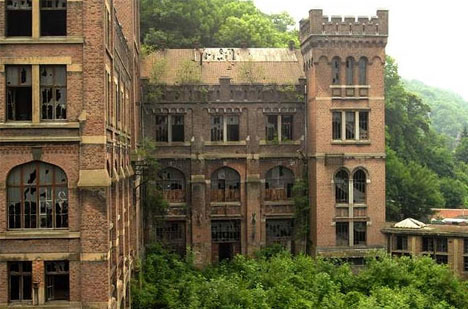
Continuing the theme of post-industrial landscape, many urbex photographers in recent years have documented the interior and exteriors of abandoned factories and mines. Unlike the Bechers' work, these images often have much in common with traditional landscape photography: the photographers are clearly trying to convey a narrative content. Some good examples of this can be seen by comparing the many images taken of the disused Hazard Cheratte colliery in Belgium. Built in 1860 this mine remained in use up until 1977, though with a vastly reduced workforce of 600 miners in comparison with its heyday when over 1500 miners worked there. It is now a popular site for urbex photographers to visit and is well documented on urbex sites.
Examples of different approaches to photographing the gothic-style exterior buildings of the Hazard Cheratte colliery are shown below:

http://upload.wikimedia.org/wikipedia/commons/thumb/a/a5/Hasard_Cheratte.jpg/800px-Hasard_Cheratte.jpg
Coal mine Hasard Cheratte in Belgium by P.J.L LaurensIn the picture above, the photographer has used black and white photography to emphasise the variations in tonal range along the surface of the exterior walls, strongly capturing the differences between the paler broken glass of the windows and the darkness of the rooms behind them. The photograph has been taken from ground level with a slight upward tilt, causing the building to appear to 'loom' over the viewer. In the resulting image, the dramatic nature of the architecture contrasts with the shattered windows and the building looks like a ruined - but once elegant - castle. By comparison, the image below - taken front-on with the uprights and horizontals correctly aligned - is a far less interesting composition to look at. Additionally, the camera has obviously metered for the bright grey sky thereby blowing out a lot of the foreground detail which the photographer appears to have tried to bring back through lightening the whole image. The use of HDR or filters might have substantially reduced the likelihood of this happening.

http://www.hammertonail.com/better-films/places-to-film-5-abandoned-europe/
Like the first image, the interesting composition of the shot below and the use of black and white has worked very effectively to create a startling and slightly intimidating view of the building. The viewer is made to feel that they are very small in comparison with the size of the structure and I think this image is my favourite of those shown here because it conveys the tonal qualities of the shadowed walls so effectively. It may be that a filter or vignette effect has been used on the sky to the far left and if so it's use is justified because it provides a border of sorts to the whole image.

http://www.forbidden-places.net/urban-exploration-hasard-collieries-cheratte
http://www.forbidden-places.net/explos/4/1.jpg
The photograph below has obviously been subject to some level of HDR treatment, though whether at the time of shooting or in post production is not known. There is a strange 'bleached-out' lightness across much of the image which does nothing to enhance it whatsoever; no attempt has been made to integrate the tonal values within this picture and - as is the case with many HDR images available on the internet - it would appear that the author is unaware of the fundamental rules that govern how light falls. The overall result is a tonally 'flat' image that dips suddenly and unaccountably into shadow at one point only (on the right, behind the main building at the front), that is rich in detail but impoverished of any emotional meaning.

http://www.haikyo.org/abandoned/mines/hasard-cheratte-mine/
The photograph below shows a much gentler approach to the subject than in the preceding shots. The building has been captured in a gentle, golden evening light and looks like a forgotten castle amidst the greenery of the hillside in which it stands. Although the damage to the windows is evident, the emphasis in this picture is upon the architectural detail and it is the overgrowth of the surrounding trees which tells the viewer that this is an abandoned site rather than any particular signs of wear and tear on the structure of the building itself. A filter appears to have been used on the lens since the sky is a rich dark blue and additionally the pale yellow light falling on the building and foreground greenery is slightly out of keeping with the rest of the shot, indicating that it was probably enhanced in post-production, possibly a result of subtle HDR tonemapping.

http://www.oblivionstate.com/forum/showthread.php/4522-Hasard-Cheratte-Belgium-Sept-2012
By comparing these five different approaches to photographing the same site it is possible to begin to extrapolate good practice from bad. The simplest shots with the most dramatic composition convey the most powerful narrative with the black and white images probably being the strongest. The closer the camera is to the fabric of the building itself, the greater the drama; distant shots revealing the structure within its landscape setting paint a broader, less emotionally intense picture of the site. If HDR is utilised then it needs to be used with discretion and a clear understanding of how light behaves, otherwise the results can look startling for all the wrong reasons.
With the exception of scenes from the abandoned Graig Ddu Slate Mine, the subject for my Negotiated Studies One will primarily be abandoned dwelling spaces rather than industrial sites, so having examined some approaches to capturing the exterior of buildings, my next area of research is to explore the methods that people have used to photograph abandoned houses and the intimacy of their interior spaces.
Dutch network engineer Niki Feijen has been photographing abandoned interior dwelling spaces as a hobby for several years and following publication of some of his images by the Daily Mail newspaper in April 2013, his work has acquired a large cult following from people who might otherwise have not even heard of the urbex genre. Feijen travels Europe photographing abandoned sites using a Nikon D800 full frame camera. He has documented many post industrial sites including Pripyat (Chernobyl), but his most popular work documents the abandoned interiors of Dutch houses, as illustrated below:

He is a keen proponent of HDR technology, the application of which which lends his work a surreal, almost 'painted' quality. Whilst this creates an interesting level of detail in the photographs, it also gives rise to odd effects; the artificial redistribution of tonality leads to an overall dulling of colours which then need to be re-mapped - not always successfully - and confusion over the actual sources of light lend the scene a plastic, 'miniaturized' look. In the image above for example, the main source of illumination obviously comes from a window to the right, out of shot. Without the introduction of artificial light sources - for which there is no evidence in this picture - the right wall and its furniture and the right-hand portion of the wall behind the bedhead should therefore be much darker than the left-hand wall, yet they appear to have some kind of inbuilt luminescence that equalises everything out. Similarly, an additional two sources of illumination from behind the viewer's left and right shoulders appear to be creating highlights on the pram in darkened shed below. This is a shame because it creates a strong sense of falsehood in what would have otherwise been fascinating images.

With the exception of scenes from the abandoned Graig Ddu Slate Mine, the subject for my Negotiated Studies One will primarily be abandoned dwelling spaces rather than industrial sites, so having examined some approaches to capturing the exterior of buildings, my next area of research is to explore the methods that people have used to photograph abandoned houses and the intimacy of their interior spaces.
Niki Feijen
Dutch network engineer Niki Feijen has been photographing abandoned interior dwelling spaces as a hobby for several years and following publication of some of his images by the Daily Mail newspaper in April 2013, his work has acquired a large cult following from people who might otherwise have not even heard of the urbex genre. Feijen travels Europe photographing abandoned sites using a Nikon D800 full frame camera. He has documented many post industrial sites including Pripyat (Chernobyl), but his most popular work documents the abandoned interiors of Dutch houses, as illustrated below:

Abandoned Dutch Farm House by Niki Feijen
http://artofurbex.smugmug.com/Urbex/nf/27453304_k2WGwG#!i=2468407191&k=p7d3Tw7&lb=1&s=L

When there is more light available to the camera however, Feijen's images are a lttle more pleasing:
 |
Abandoned Dutch Living Room by Niki Feijen
http://artofurbex.smugmug.com/Urbex/nf/27453304_k2WGwG#!i=2326250875&k=gBM9cTz&lb=1&s=L
|
Paul White
By contrast with Feijen's HDR interiors, landscape photographer Paul White eschews digital photography in favour of traditional sheet film and a Wista 5x4inch field camera for his capture of ruined Welsh homesteads. In the biography on his website he describes how much he enjoys the actual process of darkroom development from start to finish and says he employs very little by way of 'darkroom trickery' beyond the occasional lightening of dark shadows to reveal detail which might otherwise be lost or the addition of tone to an otherwise featureless sky (White, 2013, para 2). A keen student of the works of Edward Weston and Aaron Siskind, White looks for both essential substance and surface detail in his shots.


Baron
Hill Stables by Paul White
The two shots shown above show the remains of a 17th century stately home in Angelsey, called Baron Hill. Vacant since a fire during the Second World War, the house has gradually slipped into ruin and now only the bare traces of its structure remain. In these photographs White has captured not just the crumbling grandeur of once magnificent architecture but also the influx of greenery as nature takes the site over. There is an immensely subtle tonal range evident in these photographs which lends a particular kind of dignity to these images, one conspicuously lacking in Feijen's work. The influence of Siskind is particularly evident in the way that White has captured the effects of decay upon the door and lintels of the disused stables.
White also captured several shots of the well known Gwylfa Hiraethog ruins on the Denbigh Moors back in 1997. Abandoned in the 1950's, the decay of this once beautiful house has been spectacularly rapid and there is now very little left of the few buildings that can be seen in White's shots. To this extent, his work can be viewed as forming part of a visual archive, documenting such buildings before they are lost to sight altogether. Originally built of wood in the 1890's before being re-built with masonry and extended between 1908-11, at 1627 feet above sea level Gwylfa Hiraethog was once known as the highest inhabited house in Wales and in possession of the widest views in Britain (White, 2013). Whilst White stops short of including these views in his images from the site, he nonetheless shows the house in its wider setting of the bleak moorland landscape; perhaps the most powerful aspect of these images is the view of the sky itself through the rib-like remains of the windows, somewhat reminiscent of a ruined abbey.

GWYLFA HIRAETHOG,
Denbigh Moors, Denbighshire 1997 by Paul White

GWYLFA HIRAETHOG, Denbigh Moors, Denbighshire 1997 by Paul White
http://www.welshruins.co.uk/imgs/gallery/7784/7784_2433942794e5b3cb963e7c.jpg
These views of the house within its original setting add an extra dimension to the viewing experience as one is caused to speculate about the motivations to build in such an isolated place and what the experience of actually living day to day in such a location might have been like.
Whilst abandoned mansions and stately homes are few and far between in the mountainous landscape of Snowdonia, a search through White's catalogue of Welsh ruins turns up many images of abandoned farmhouses and dwelling places that look superficially similar to those that can be found in my local landscape and such images provide a wealth of clues as to the best ways to approach capturing these structures. Some interesting example can be found amongst White's images of the Cwmystwyth Lead Mine ruins. These mines are close to where White lives, consequently he has been able to record them over many years, perfecting his technique as he goes. Compare, for example the two images below. The first one dates from 1993 and whilst it is an atmospheric shot of the barren landscape, there are evidently some problems with composition.
 CWMYSTWYTH LEAD MINES,
Ceredigion 1993 by Paul White
http://www.welshruins.co.uk/imgs/gallery/7784/7784_11115568864b8bc70e572d4.jpg
http://www.welshruins.co.uk/photo4475618.html

CWMYSTWYTH LEAD MINES,
Ceredigion 2010 by Paul White
http://www.welshruins.co.uk/imgs/gallery/7784/7784_431725744d0dba0269467.jpg
http://www.welshruins.co.uk/imgs/gallery/7784/7784_431725744d0dba0269467.jpg
http://www.welshruins.co.uk/cwmystwyth-lead-mines-ceredigion-2010#photo

CWMYSTWYTH LEAD MINES,
Ceredigion 1993 by Paul White
http://www.welshruins.co.uk/imgs/gallery/7784/7784_15303827564b8bc716425a8.jpg
http://www.welshruins.co.uk/imgs/gallery/7784/7784_15303827564b8bc716425a8.jpg
http://www.welshruins.co.uk/photo4475620.html#photo
This photograph appears to be a brave attempt to contrast the fallen rubble on the ground with the standing wall to the right and the distant hillside which is littered with such stones. It is however an uncomfortable image to look at. There is no clear focal point, the stones all seem to be of similar size and the harsh medium of black and white does not readily lend itself to this subject, creating a sort of undifferentiated visual porridge in which it is difficult for the viewer to understand what they are being asked to see. This photograph might have been more successful had it been taken in colour, allowing for a subtlety of tone to describe the various elements.
Of his colour work, White says that although the quality is good enough for the resolution on computer screens, 'they are not on the same par as the black and white images' and therefore do not comprise part of his main collection, although they are available on request. This is a great shame as many of his colour images are nicely composed and convey a great deal of the stillness and isolated atmosphere of these places.

Mynydd-du, Mynydd-du
Commin, Rosebush, Pembrokeshire 2013 by Paul White
http://www.welshruins.co.uk/imgs/pages/7784_4756027895231c3e430b18.jpg
http://www.welshruins.co.uk/page10960.html
http://www.welshruins.co.uk/imgs/pages/7784_4756027895231c3e430b18.jpg
http://www.welshruins.co.uk/page10960.html

Mynydd-du, Mynydd-du
Commin, Rosebush, Pembrokeshire 2013 by Paul White
http://www.welshruins.co.uk/imgs/news/7784_16257959555231cf0d899b7.jpg
http://www.welshruins.co.uk/page10960.html
http://www.welshruins.co.uk/imgs/news/7784_16257959555231cf0d899b7.jpg
http://www.welshruins.co.uk/page10960.html
Colour therefore would seem to be the ideal medium for photographing abandoned spaces within the setting of their rural landscape, since natural elements are easier for the viewer to perceive when shown in their natural hues, whilst intact architectural features, surface detail and close-up texture would seem to have a greater impact when recorded in black and white. There is also a middle ground to be found when colours are not overly saturated (as evinced by Feijen's HDR work), but are muted and subtle.
LC Ferrari
A good example of this subtle approach to colour can be found in the work of photographer LC Ferrari whose dark and dramatic images from the interior of the Eastern State Penitentiary in Philadelphia, Pennsylvania were recently featured in the online magazine The Photo Argus. The prison was operational from 1829 until 1971 and once housed Al Capone. Despite the fact that the prison was originally constructed as a place of reform and rehabilitation rather than simple punishment, it was obviously a harsh environment in which to be incarcerated and solitary confinement was extensively used there in order to keep the prisoners under control.

ESP 2012 by LC Ferrari
http://m1.behance.net/rendition/modules/3812069/disp/6d9b4e787c0d1cf390a5a0e1b9c8f4ac.jpg
http://www.behance.net/gallery/ESP-2012/4822561
http://m1.behance.net/rendition/modules/3812069/disp/6d9b4e787c0d1cf390a5a0e1b9c8f4ac.jpg
http://www.behance.net/gallery/ESP-2012/4822561
Whether due to the influence of the nature of the institution being photographed or because the background of the photographer is one of graphic design, the photographs from this shoot display a certain robustness which is lacking in White's gentle images.

ESP 2012 by LC Ferrari
http://m1.behance.net/rendition/modules/385213/disp/0e97562977c074faac7e2dae73a998ce.jpg
http://www.behance.net/gallery/ESP-2012/4822561
http://www.behance.net/gallery/ESP-2012/4822561
Verticals and horizontals are strongly emphasised to convey the harshness of this unforgiving environment and it is a treatment which seems to suit the subject very well as tapering lines lead in from the edges of the picture, past gates and bars and along narrow corridors. Ferrari has used his designer's eye to inform the viewer of a harsh place that offers no comfort, no view of the outer world beyond a glimpse of sky above the high walls.

ESP 2012 by LC Ferrari
http://m1.behance.net/rendition/modules/385888/disp/3ec24b3c0dced60c2e4f56d4299d7cb3.jpg
http://www.behance.net/gallery/ESP-2012/4822561
http://m1.behance.net/rendition/modules/385888/disp/3ec24b3c0dced60c2e4f56d4299d7cb3.jpg
http://www.behance.net/gallery/ESP-2012/4822561
There is an emphasis on tonal contrast in these images but the colours remain restrained and joyless, in keeping with the subject matter. This sense of place when photographing an abandoned site is one of the most important elements since the success of such a photograph largely depends upon the ability of the photographer to deliver a clear narrative. In the picture below, for example, we are invited to imagine what the room must have been like when occupied by prisoners, caged like animals behind the wire netting. Ferrari has chosen not to push the gate open and allow us to identify with the personal living conditions of the inmates themselves, opting instead for the view offered to the guards wherein the prisoners lose their individuality, becoming a mass of incarcerated inmates to be herded together and controlled in a comfortless environment that offers neither socialisation nor privacy.
 ESP 2012 by LC Ferrari
http://m1.behance.net/rendition/modules/381207/disp/9795957dc83f6da2a97f86183e14dd38.jpg
http://www.behance.net/gallery/ESP-2012/4822561
Dan Circa
A further example of urbex photography that retains its sense of place is to be found in the work of Manchester-based photographer Dan Circa, whose visual documentation of the so-called 'Red Dress Manor' - a derelict eighteenth century Powys dairy farm last occupied some forty years ago -was recently featured in the Daily Mail newspaper.
 Red Dress Manor by Dan Circa
http://i2.walesonline.co.uk/incoming/article6242166.ece/ALTERNATES/s2197/RNP_mai_2501013House20JPG-6242166.jpg
http://www.walesonline.co.uk/news/wales-news/frozen-time-spellbinding-pictures-inside-6242344
In contrast with Ferrari's dominant narratives however, Circa's approach allows his subject and its rich interior detail to speak for themselves. Circa makes effective use of available light to create a natural atmosphere and draw attention to fascinating details within the environment. In the image below for example, the stream of daylight highlighting the curtain that pools on the floor by the bed lead the eye downward from the centre of the window toward the crumpled bed covers. This well-lit scene thus appears strangely intimate and somehow friendly, despite the obvious levels of decay.
 Red Dress Manor by Dan Circa
http://i3.walesonline.co.uk/incoming/article6242145.ece/ALTERNATES/s2197/RNP_mai_2501013House06JPG-6242145.jpg
http://www.walesonline.co.uk/news/wales-news/frozen-time-spellbinding-pictures-inside-6242344
In the image of the three doors below, Circa has again made use of available light sources by opening the doors a little, casting crossing shafts of light along the floor. Because of this, a scene that could have otherwise looked somewhat cold and forbidding instead invites the viewer to step through the doorways and explore the rooms beyond.

Red Dress Manor by Dan Circa
http://i1.walesonline.co.uk/incoming/article6242160.ece/ALTERNATES/s2197/RNP_mai_2501013House16JPG-6242160.jpg
http://www.walesonline.co.uk/news/wales-news/frozen-time-spellbinding-pictures-inside-6242344
http://i1.walesonline.co.uk/incoming/article6242160.ece/ALTERNATES/s2197/RNP_mai_2501013House16JPG-6242160.jpg
http://www.walesonline.co.uk/news/wales-news/frozen-time-spellbinding-pictures-inside-6242344
As well as photographing the entirety of the rooms in this building, Circa captures the close-up detail and texture of individual objects, thereby establishing a relationship between the viewer and the house itself.

Red Dress Manor by Dan Circa
http://i2.walesonline.co.uk/incoming/article6242155.ece/ALTERNATES/s2197/RNP_mai_2501013House13JPG-6242155.jpg
http://www.walesonline.co.uk/news/wales-news/frozen-time-spellbinding-pictures-inside-6242344
http://i2.walesonline.co.uk/incoming/article6242155.ece/ALTERNATES/s2197/RNP_mai_2501013House13JPG-6242155.jpg
http://www.walesonline.co.uk/news/wales-news/frozen-time-spellbinding-pictures-inside-6242344
Circa also takes care to document the relationship between the objects in the house. The red dress (for which the house has been named) hangs in a wardrobe in one of the bedrooms (below left) and is also shown being worn by a former occupant of the house - Ellen Jones - in a photograph (below right).


Red Dress Manor by Dan Circa
http://i3.walesonline.co.uk/incoming/article6242143.ece/ALTERNATES/s2197/RNP_mai_2501013House04JPG-6242143.jpg
Red Dress Manor by Dan Circa
http://i1.walesonline.co.uk/incoming/article6242142.ece/ALTERNATES/s2197/RNP_mai_2501013House03JPG-6242142.jpg
http://www.walesonline.co.uk/news/wales-news/frozen-time-spellbinding-pictures-inside-6242344
http://i1.walesonline.co.uk/incoming/article6242142.ece/ALTERNATES/s2197/RNP_mai_2501013House03JPG-6242142.jpg
http://www.walesonline.co.uk/news/wales-news/frozen-time-spellbinding-pictures-inside-6242344
Describing this project as an exploration of 'beauty in decay', Circa says: 'I felt like I was in someone’s home uninvited, I expected the owner to walk round every corner I saw.. I am documenting things that someone once cared about.. People are amazed to see the pictures, especially when they see it's a place with personal belongings in (De Graaf, 2013).' This respect for the intrinsic wholeness of the house and its belongings as the former property of an individual with a personal story comes across clearly in Circa's photographs and enhances their intimacy.
Daniel Marbaix and Daniel Barter are two photographers from London who teamed up through their mutual love of urbex photography. Barter having originally trained in restoration and Marbaix in zoology, they now travel through Europe, Japan and the USA photographing abandoned places. They are co-authors of a book of their photographs from America, entitled States of Decay. The subject matter for their photographs ranges from abandoned homes, schools, churches, factories, derelict industrial complexes and mines to hospitals and asylums. They purposefully do not give out information about the location of the sites that they photograph, presumably in order to help preserve such sites from thieves and vandals who might otherwise destroy the integrity of such places.
 Doctor's House, Germany by Daniel
Marbaix
http://i.dailymail.co.uk/i/pix/2013/11/07/article-2489974-193F369200000578-872_964x628.jpg
http://www.dailymail.co.uk/news/article-2489974/An-urban-explorers-holiday-album-Traveller-spends-free-time-visiting-abandoned-buildings-world-despite-arrested-20-times-trespass.html
Although they have photographed many fascinating domestic interiors of abandoned houses such as the bedroom shown above from a former doctor's house in Germany, their skilled and beautiful work truly comes into its own when documenting vast derelict industrial sites.

Whilst their HDR work can at times look a little heavy-handed within a domestic setting, the sheer scale and complexity of these industrial subjects benefits enormously from this type of post-production work because the re-mapping of tonal values and sharpening of detail creates the sensation of a visual harshness entirely in keeping with the engineered technology of these environments.
 Image from 'States of Decay' by
Daniel Marbaix and Daniel Barter
http://i.cdn.turner.com/ireport/sm/prod/2013/11/20/WE01036393/3047217/3jpg-3047217_p9.jpg
http://ireport.cnn.com/docs/DOC-1062747


 ECVB power station in Ghent, Belgium
by Daniel Marbaix
http://i.dailymail.co.uk/i/pix/2013/11/07/article-2489974-193F448200000578-345_964x672.jpg
http://www.dailymail.co.uk/news/article-2489974/An-urban-explorers-holiday-album-Traveller-spends-free-time-visiting-abandoned-buildings-world-despite-arrested-20-times-trespass.html
HDR has also been used to good effect in Marbaix' image of the ECVB power Station in Ghent, shown above. The relative sharpness of the foreground combined with a corresponding increase in contrast gives this complex and potentially busy image greater depth and meaning than it would probably otherwise have.
Photographing Abandoned Buildings
In order to stay current with contemporary developments it is always worth checking out the best working practices in any given photographic genre. The next step in my researches therefore involved checking out advice on the best way to go about photographing abandoned buildings. Sadly, most tips on offer suggested locating an abandoned building, going inside said building and photographing it! The only really useful tip I found was from the Digital Photography School who in addition to the normal advice to use a tripod and shoot on manual suggested the use of a torch to create light in otherwise dark areas, not something I'd ever really considered before.
______________________________________
Planning
Using ideas abstracted from the above researches I created a basic work schedule (see below), began to list possible locations that would provide good subjects for my Abandoned Spaces photography project and arrived at a set of time-frames for my shoots.
Because of the unpredictable nature of the weather in the mountains it was necessary for me to work a great deal of flexibility to this schedule and therefore gave myself an eight week window at the end of the summer to achieve my aims. The choice of this time of year was based on several factors, most notably the light, which would be softer, with more red tones in the early autumn than at midsummer due to the angle of the sun being lower in the sky, even at midday and I wanted to capture a certain mellowness to my ancient subjects which would not be possible in a harsh light. Additionally, because summer comes late to the mountains and only lasts around six weeks I knew that the corresponding variation in colours of the surrounding landscapes would give my shots a greater degree of interest at this later time of year than earlier in the season when everything looks predominantly green.
_______________________________________
I began
photographing Bryn Eithin for this project on a lovely sunny evening
in July and obtained some dramatic images of the cottage bathed
in rose-coloured light as the sun went down behind the mountains
across the valley.

Due to the late hour, the front of the cottage was completely in shadow but the back of it still caught the sun’s rays, evoking a somewhat gentler mood in the mellow evening light.

I took a great many shots from inside the building of the
evening landscape viewed through the empty windows and gaping doorway.


Reviewing
these images back home I felt that although I’d accurately captured
the feeling of being there on a summer’s evening my pictures were
making a stronger statement about the evening light than they were
about Bryn Eithin itself. I therefore decided to return during midday to capture the house in full sunlight. The opportunity to do
this presented itself on Sunday 21st of July – beautiful warm day with a few fluffy clouds in an
otherwise blue sky. Using Paul White’s sensitive shots as my
inspiration, I worked my way
around the whole of the exterior of the house with the camera
steadied on a tripod, trying to express the feeling of this cottage’s
isolated position within the landscape. I then photographed the
interior, exploring details and textures. In this second session I took over three hundred shots and obtained some pleasing images of the cottage in its vast scenic setting, clouds casting shadows over the distant hills in the background.

 Undegun Gallery
It being the run-up to Halloween, we
then returned to the hotel so that Sue could capture some
motion-blurred ‘ghost’ pictures of Katie creeping down the
corridor, but when Katie crouched behind one of the doors waving a
‘disembodied ghostly hand’ in the doorway for Sue to photograph I
suddenly realised I was looking at a great narrative shot: a
waif-like child hiding in the corner of a bleak, empty room! Katie
is a natural actor and superb model and I got some fabulous pictures
of her looking like a child on an anti-bullying poster in those empty
spaces, the only drawback being that many of the longer hand-held
exposures had some degree of blur due to the low levels of daylight.

I also got a couple of nice shots of Katie in more natural poses. Provided the right kind of lighting is used, this venue will readily lend itself to all kinds of shoots - fashion and portrait immediately spring to mind - since the unusual backgrounds will immediately produce a heightened sense of drama.


Whilst I was pleased with several of my shots of the bedrooms, the areas in which I had the most fun were to either end of the darkened corridor. Inspired by Dan Circa’s image of doors in the Red Dress Manor, I experimented by wedging the hotel room doors fractionally open in order to control the way the beams of light slanted along the walls and floor of the corridor - creating a sense of mystery as to what lay behind them - and was able to obtain three or four shots that can definitely be included in the final book.
I also extensively experimented with capturing identical scenes using different exposure values during this shoot in order to experiment with manual HDR, (bringing my total number of RAW files to over four hundred) but obtained more precisely controlled results by directly creating over and under-exposed copies of single images in Adobe's Camera Raw Editor back home. By subsequently layering these in Adobe Photoshop I was able to reveal much of the detail and recreate the unsettling mood of the environment.

Graig Ddu - Aug 2013


A test shot from the front of the chapel merely showed the silhouette of
the mountain’s edge and it was not until I clambered over the rocks to view
it from behind and saw the sunlight on the opposite mountain wall
through the windows that I knew I had something exciting to work with. I
can remember this being an intact building on my first visit to the
site back in the late 1980’s. It still has its roof in the photograph below from the Penmorfa website taken in the year 2000.


http://www.llechicymru.info/t000952.english.htm
http://www.grantonline.com/pugh-family-genealogy/places/slate-quarries/ffestiniog/blaenau-ffestiniog-quarries.htm
________________________________________________________________________________
Summary
My shoots for this project now completed, it remained only for me to shortlist the most successful images to be printed in a book in readiness for my Final Exhibition. Senior Photography Lecturer Stewart Edwards offered useful guidance as to the types of image that would work best on the printed page and also gave invaluable advice on the use of post-production editing in order to give these images the kind of visual impact necessary. Although I wanted the images to 'pop', I was also trying to maintain a fairly natural look, so fair bit of juggling with the levels was involved.
My final selection of images to be put into the book consists of twelve images from Graig Ddu, a triptych from Undegun, two images from the first Abandoned Hotel, three from Cwmorthin and six from Bryn Eithin. Below is a thumbnail composite of the final images from Graig Ddu and another below that of the colour photographs. Larger copies of all but two of these images may also be be viewed on my Infinite Sky Flickr page (the first Abandoned Hotel being excluded for reasons stated earlier in this journal).
I believe that I have succeeded in my aim to create images of abandoned spaces that speak of the process of transition and show the inherent beauty that can be found in the natural processes by which things in the material world return to the source of their arising.
_______________________________________
Evaluation
This project has been one of the most interesting that I have undertaken for my film and photography degree at Glyndwr. Meeting the challenges presented by working with a wide variety subjects in many different locations has enabled me to deepen my understanding of both the technical and the aesthetic requirements of the genre. In particular, my proficiency in the use of post-production processing has developed as a direct result of the work I had to undertake in order to bring those photographs that were taken in less than ideal conditions up to a high standard. Although satisfied that the images produced for this project are the best that I could have taken at the time, the way that the light works in outdoor locations can often only be understood by actually being there and having photographed Cwmorthin Quarry on a November morning when the sun was already obscured by the surrounding mountains, I wish in hindsight that I had made Cwmorthin my first location for this project and photographed it back in June when the sun was at a much higher angle.
I especially enjoyed researching the history of the Welsh slate-mining industry and doing so helped foster a strong sense of connection with my subject-matter. I believe this awareness assisted me to capture images that emphasise the interdependence between the abandoned buildings and the natural resources which gave rise to and shaped their original construction. One of my aims in this project was to demonstrate to the viewer how extraordinary it must have been to live in these remote and often harsh environments and although it sometimes took several visits to these locations to achieve this, I believe I eventually succeeded.
In contrast with the outdoor shots, my work with the interior spaces of the two abandoned hotels needed far less post-production work. This is directly attributable to that fact that the lighting conditions were more closely under my control with fewer variables at play. It is unfortunate that permission to photograph the the first abandoned hotel and the empty educational building was conditional upon my agreement not to upload any of the images from either shoot as it would have been good to include images from them within this reflective journal. This is an issue that I will be far more aware of in the future, since it is a waste of time and resources to spend days recording and processing images that cannot subsequently be shared with any audience.
I intend to continue developing my work documenting abandoned spaces and undertaking this project has provided me with a clear set of criteria from which to proceed.
_______________________________________
Daniel Marbaix and Daniel Barter
Daniel Marbaix and Daniel Barter are two photographers from London who teamed up through their mutual love of urbex photography. Barter having originally trained in restoration and Marbaix in zoology, they now travel through Europe, Japan and the USA photographing abandoned places. They are co-authors of a book of their photographs from America, entitled States of Decay. The subject matter for their photographs ranges from abandoned homes, schools, churches, factories, derelict industrial complexes and mines to hospitals and asylums. They purposefully do not give out information about the location of the sites that they photograph, presumably in order to help preserve such sites from thieves and vandals who might otherwise destroy the integrity of such places.
 Doctor's House, Germany by Daniel
Marbaix
http://i.dailymail.co.uk/i/pix/2013/11/07/article-2489974-193F369200000578-872_964x628.jpg
http://www.dailymail.co.uk/news/article-2489974/An-urban-explorers-holiday-album-Traveller-spends-free-time-visiting-abandoned-buildings-world-despite-arrested-20-times-trespass.html
Although they have photographed many fascinating domestic interiors of abandoned houses such as the bedroom shown above from a former doctor's house in Germany, their skilled and beautiful work truly comes into its own when documenting vast derelict industrial sites.

Blast Furnace in Belgium by Daniel
Marbaix
http://i.dailymail.co.uk/i/pix/2013/11/07/article-2489974-193F35BF00000578-824_964x637.jpg
http://i.dailymail.co.uk/i/pix/2013/11/07/article-2489974-193F35BF00000578-824_964x637.jpg
Whilst their HDR work can at times look a little heavy-handed within a domestic setting, the sheer scale and complexity of these industrial subjects benefits enormously from this type of post-production work because the re-mapping of tonal values and sharpening of detail creates the sensation of a visual harshness entirely in keeping with the engineered technology of these environments.
 Image from 'States of Decay' by
Daniel Marbaix and Daniel Barter
http://i.cdn.turner.com/ireport/sm/prod/2013/11/20/WE01036393/3047217/3jpg-3047217_p9.jpg
http://ireport.cnn.com/docs/DOC-1062747
In both the photograph above by Marbaix and Barter and the cooling tower below by Marbaix, HDR has been utilised to lighten areas that would otherwise have been dark, thereby adding definition and increasing depth.

Belgian Cooling Tower by Daniel
Marbaix
http://i.dailymail.co.uk/i/pix/2013/11/07/article-2489974-193F423000000578-680_472x705.jpg
http://www.dailymail.co.uk/news/article-2489974/An-urban-explorers-holiday-album-Traveller-spends-free-time-visiting-abandoned-buildings-world-despite-arrested-20-times-trespass.html
http://i.dailymail.co.uk/i/pix/2013/11/07/article-2489974-193F423000000578-680_472x705.jpg
http://www.dailymail.co.uk/news/article-2489974/An-urban-explorers-holiday-album-Traveller-spends-free-time-visiting-abandoned-buildings-world-despite-arrested-20-times-trespass.html
The images above and below show two contrasting treatments of a similar subject, cooling towers in this instance. In the photograph above, Marbaix has used HDR to enhance the linear aspect of the structure, allowing the fabric of the building itself to tell the viewer about its vast dimensions.

Image from 'States of Decay' by
Daniel Marbaix and Daniel Barter
http://i.cdn.turner.com/ireport/sm/prod/2013/11/20/WE01036393/3047219/8jpg-3047219_p9.jpg
http://ireport.cnn.com/docs/DOC-1062747
http://i.cdn.turner.com/ireport/sm/prod/2013/11/20/WE01036393/3047219/8jpg-3047219_p9.jpg
http://ireport.cnn.com/docs/DOC-1062747
By comparison, Marbaix and Barter's dramatic photograph above abandons detail in favour of strong tonal contrast to describe the interior space of the tower. It has been taken at an off-centre angle to create the foreboding sense that the viewer is trapped in the darkest point of a well, as though in an oubliette.
 ECVB power station in Ghent, Belgium
by Daniel Marbaix
http://i.dailymail.co.uk/i/pix/2013/11/07/article-2489974-193F448200000578-345_964x672.jpg
http://www.dailymail.co.uk/news/article-2489974/An-urban-explorers-holiday-album-Traveller-spends-free-time-visiting-abandoned-buildings-world-despite-arrested-20-times-trespass.html
HDR has also been used to good effect in Marbaix' image of the ECVB power Station in Ghent, shown above. The relative sharpness of the foreground combined with a corresponding increase in contrast gives this complex and potentially busy image greater depth and meaning than it would probably otherwise have.
Photographing Abandoned Buildings
In order to stay current with contemporary developments it is always worth checking out the best working practices in any given photographic genre. The next step in my researches therefore involved checking out advice on the best way to go about photographing abandoned buildings. Sadly, most tips on offer suggested locating an abandoned building, going inside said building and photographing it! The only really useful tip I found was from the Digital Photography School who in addition to the normal advice to use a tripod and shoot on manual suggested the use of a torch to create light in otherwise dark areas, not something I'd ever really considered before.
______________________________________
Planning
Using ideas abstracted from the above researches I created a basic work schedule (see below), began to list possible locations that would provide good subjects for my Abandoned Spaces photography project and arrived at a set of time-frames for my shoots.
Because of the unpredictable nature of the weather in the mountains it was necessary for me to work a great deal of flexibility to this schedule and therefore gave myself an eight week window at the end of the summer to achieve my aims. The choice of this time of year was based on several factors, most notably the light, which would be softer, with more red tones in the early autumn than at midsummer due to the angle of the sun being lower in the sky, even at midday and I wanted to capture a certain mellowness to my ancient subjects which would not be possible in a harsh light. Additionally, because summer comes late to the mountains and only lasts around six weeks I knew that the corresponding variation in colours of the surrounding landscapes would give my shots a greater degree of interest at this later time of year than earlier in the season when everything looks predominantly green.
Schedule
for Negotiated Studies One: Abandoned Spaces
TASK
|
DETAILS
|
DEADLINE
|
Find subjects:
|
Bryn
Eithin;
Burned-Out
Shepherd's House;
Former
Educational Establishment;
Derelict
Hotel 1;
Derelict
Hotel 2;
Graig
Ddu;
Cwmorthin
Quarry;
Rhosydd Chapel.
|
31 Oct
|
Research
derelict spaces and examine shooting considerations
|
Research
specific images from abandoned dwelling places online. Compare
with images of industrial spaces and notate differences in
approach if any. Examine lighting, angles, lenses and depth of
field used.
Research chosen locations
as deeply as possible, examining history and current images.
|
30 July
|
Transport and
accessibility
|
Research access and
possible transport
|
02 March
|
Schedule
:
|
Bryn
Eithin
Graig
Ddu
Burned-Out
Shepherd's House
Former
Educational Establishment
Derelict
Hotel 1
Derelict
Hotel 2
Cwmorthin
Quarry
Rhosydd Chapel
|
July
-Aug
July
- Aug
Aug
– Sept
Aug
Aug
Nov
Sept-Oct-Nov
Sept-Oct-Nov
|
Editing
|
Continuous
|
06 Jan
|
Update online
Journal
|
Upload
images to journal together with all research, links to external
sites and final selection of images (excluding those from
sites who wish to remain unidentified).
Upload images to Flickr account. |
21
Jan
|
Email Tutors
|
Email all links to
tutors: Blogger, Flickr, Fb page
|
28 Jan
|
* Blue
– task completed
Black – to do
Red
– to do urgent
Photographic
Journal
Bryn Eithin - July - Aug 2013
Bryn Eithin - July - Aug 2013
Bryn
Eithin (‘Gorse Hill’) is an isolated cottage situated in the
foothills of Manod Bach, some three miles from Blaenau Ffestiniog.
Older members of the community can still remember people living
there, but it has been uninhabited since the 1960’s. It remained
in relatively good condition until the lead was taken from the roof
sometime during the 1980’s after which the roof began to gradually
fall in. Over the next year the remaining roof slates were removed
and the beams stacked in a pile near one of the fireplaces. It is
now essentially a stone ruin filled with nettles and open to the sky.

Bryn Eithin from the front
Due to the late hour, the front of the cottage was completely in shadow but the back of it still caught the sun’s rays, evoking a somewhat gentler mood in the mellow evening light.

Bryn Eithin from the back

View across to the Rhiniog mountains from Bryn Eithin front window
I also captured details of the interior itself: the two
fireplaces and chimneys, the mossy roof beams on the ground,
fractured cement textures from the walls and the remains of the
rusted range that once stood in the larger of the two fireplaces.


Bryn Eithin roof beams beside the smaller fireplace and the rusted range from the larger fireplace

Bryn Eithin roof beams

View from the back of Bryn Eithin
On my
return to Glyndwr University in September I showed Senior Photography
Lecturer Stewart Edwards the best of these photographs and he advised me to return to
the subject in order to improve on a couple of the shots. Due to
terrible weather in Blaenau Ffestiniog I was unable to do so until
Sunday 10th November, by which time the quality of light and the
height of the sun – even at midday – was radically different to
those from my previous shoots. My shadow was long and - when
attempting to replicate the shots I was trying to better - stretched
over the building itself, whilst the surrounding November landscape
looked drab and uninspiring. I took about fifty shots in all but
was not really pleased with any of them and decide to undertake
further post-production work with my previous pictures in order to
obtain the required results.
The
Burned Out Shepherd’s House – Nov 2013
I first
visited this derelict house in the early 1980’s when a local friend
who’d grown up in the area took me there for a walk one day. Our
path had brought us through the wooded hills of Bowydd that lie
between the villages of Manod and Tanygrisiau in the Vale of Ffestiniog. We had traversed a treacherous bog
(that was reputed to have once consumed an entire horse and
cart according to my friend) and after short climb we had rounded a steep
craggy hill to find the remains of a most beautiful stone house
nestled in its lee. Although it lacked a roof, the walls and
fireplaces were still intact, together with a couple of doorways and
an outhouse. The jewel in the crown however was the circular walled
garden enclosed by a dense evergreen hedge into which a little gate
was set. Beyond it lay a round, still curiously smooth lawn bordered
by high pines and variegated holly trees, whispering in the wind.
This
isolated house - which had been abandoned since a fire in the 1940’s
– had possessed a melancholy stillness that was quite fascinating
and (provided enough of it had remained intact during the intervening years) seemed like the ideal subject to photograph for this
project. On a rare sunny day in early November I therefore tried to
find my way back there.
Much in the landscape had changed over the course of thirty years – barbed wire fences were now erected at every turn and there was even a newly-laid tarmac pathway stretching across the fields - it took me over an hour and a half of blundering about in the woods getting ripped by the barbed wire and soaked to the knees by the bog (the area had recently received a lot of rainfall) before I was able to finally locate the burned-out house.
Unfortunately I had arrived too late; nature had already reclaimed so much of it that very little now remained of the building itself and the garden had completely disappeared under a thick blanket of tangled vegetation and trees. Only by clearing back grass and soil could I make out a couple of the smooth grey stones that had once formed the curved garden walls. Having come this far I took what photographs I could of the ruin, trying to show it within the wider context of the landscape in which it stood, but the jumble of fallen stones lying amongst the bushes looked too confusing to the eye and even as I took the photographs I knew the images from this shoot would not be worth including in the final book.


The Burned Out Shepherd’s House:
The Burned Out Shepherd’s House: an outhouse, original purpose not known

To cheer myself up afterwards I decided to follow the nearby new tarmac path to see where it would lead: to my astonishment it took me directly back home to Manod in a smooth ten minute walk!
Much in the landscape had changed over the course of thirty years – barbed wire fences were now erected at every turn and there was even a newly-laid tarmac pathway stretching across the fields - it took me over an hour and a half of blundering about in the woods getting ripped by the barbed wire and soaked to the knees by the bog (the area had recently received a lot of rainfall) before I was able to finally locate the burned-out house.
Unfortunately I had arrived too late; nature had already reclaimed so much of it that very little now remained of the building itself and the garden had completely disappeared under a thick blanket of tangled vegetation and trees. Only by clearing back grass and soil could I make out a couple of the smooth grey stones that had once formed the curved garden walls. Having come this far I took what photographs I could of the ruin, trying to show it within the wider context of the landscape in which it stood, but the jumble of fallen stones lying amongst the bushes looked too confusing to the eye and even as I took the photographs I knew the images from this shoot would not be worth including in the final book.


The Burned Out Shepherd’s House:
view of former kitchen area
The Burned Out Shepherd’s House: an outhouse, original purpose not known

The
Burned Out Shepherd’s House: view of the former front room from the old doorway.
To cheer myself up afterwards I decided to follow the nearby new tarmac path to see where it would lead: to my astonishment it took me directly back home to Manod in a smooth ten minute walk!
Empty
Educational Building - Aug 2013
The
subject for my second Abandoned Spaces shoot was an educational
establishment that has been under threat of closure for the past
year. For reasons that I cannot elaborate upon here, I was only
given permission to photograph the empty and eerily dismantled
classrooms on the proviso that I did not publish either the identity
of the place or the images I obtained online, consequently I am
unable to post any further details or photographs from this day’s
work, although I hope to receive permission to do so at a later date.
I spent around six hours there in all, documenting both the interior and exterior. The building itself is quite imposing from the outside and I was able to make use of a number of angled shots to emphasise this aspect.
I was pleased with the content of the images from this shoot, they capture the sombre and quietly desolate atmosphere of the building on the day that I visited and provide a visual record of this previously busy venue undergoing a major change. Once I uploaded the photographs to my laptop however it became apparent that they comprise a self-contained and subject-specific piece of work and are therefore unsuitable for inclusion in my book of images for Negotiated Studies One, a view confirmed by Senior Photography Lecturer Stewart Edwards when I showed them to him.
I was pleased with the content of the images from this shoot, they capture the sombre and quietly desolate atmosphere of the building on the day that I visited and provide a visual record of this previously busy venue undergoing a major change. Once I uploaded the photographs to my laptop however it became apparent that they comprise a self-contained and subject-specific piece of work and are therefore unsuitable for inclusion in my book of images for Negotiated Studies One, a view confirmed by Senior Photography Lecturer Stewart Edwards when I showed them to him.
First
Abandoned Hotel - Aug 2013
For my
third foray into photographing abandoned spaces I travelled by bus to
a distant town to photograph a derelict hotel. I had visited this
establishment with a group of friends many years before when it was
still a thriving business and remembered it to be a friendly place
with a warm and welcoming atmosphere. It had closed down several years ago at the start of the current recession and
fell into rapid decline as vandalism and theft took hold.
Although aware from internet posts that the place was now in an extreme state of disrepair, I was hoping that enough of the basic fabric of the interiors had remained intact for me to take some interesting shots. As I walked up to the entrance however my heart sank: I could see workmen busily boarding up all of the doorways and windows: the owners had finally decided that it was too dangerous for anyone to enter and sent in the contractors on the very day I had chosen to photograph it!
Although aware from internet posts that the place was now in an extreme state of disrepair, I was hoping that enough of the basic fabric of the interiors had remained intact for me to take some interesting shots. As I walked up to the entrance however my heart sank: I could see workmen busily boarding up all of the doorways and windows: the owners had finally decided that it was too dangerous for anyone to enter and sent in the contractors on the very day I had chosen to photograph it!
After
chatting to one of the workmen and explaining the educational nature
of my mission I was permitted to stand in the last open entrance -
before it too was boarded up - and capture just five minutes’ worth
of photographs from that one safe spot, provided I agreed not to post the resulting images online (and thereby possibly identify
the hotel and the kind workman who had allowed me to take them). Despite the constraints of having to shoot hand-held in poor
light and from one position only whilst trying to conduct polite
conversation with the workman (who obviously suspected that if
left on my own for even a second I would fall down the nearest hole,
break both legs and thereby get him into trouble) I was able to capture a
number of successful phtographs that made the day’s long travel there and back worthwhile.
Far from ruining the images as I had imagined, the occluded windows created a fabulous mood of gloom and
foreboding which only added to the sense of drama in the environment.
At home I was able to increase the exposure in the darkest areas using Adobe’s Camera Raw Editor. This brought up much of the
detail and enabled me to improve the sense of depth in these shots, which in my Neg One book will be combined with images from Undegun (see next entry, below).
Second
Abandoned Hotel: Undegun - Oct - Nov 2013
When the
Wrexham branch of JJB Sports closed down in 2012, the shop premises
stood empty until opened by the efforts of an arts initiative called ‘This Project’, in collaboration with RampantDragon and The Foundry, EmptySpace, The Arts Council of Wales and FocusWales aiming to transform unused shops in the Wrexham area into pop-up
galleries and community spaces in an effort to bring the community
together, encourage local enterprise and provide spaces in which
artists can work, collaborate and exhibit.
I first
heard of these plans at a North Wales film & Photography
Collective meeting during the beginning of summer 2013, but it was
not until I returned to Wrexham at the beginning of the autumn
academic term that I was able to see it put into action. Now
re-named Undegun, the gallery hosts a number of studios for artists
to rent and Film & Photography graduates Sue McGrane, Paul
Lowndes and Holly Cooper have set up their new photographic business
‘The Collective Imagery Studio’ behind the main gallery area. It was in this venue early in November that I had helped stage a retrospective exhibition of work
undertaken over the last year by students working for the North Wales
Film & Photography Collective - please see my recent Creative Futures blog entry
for a more detailed account of this.

When first
visiting Undegun to help the Collective Imagery Studio members set up
their workspace, I had seen that a corridor ran behind the former
shop floor and that a door in the far wall of this corridor was usually kept locked. Peeping through the wired glass of the door
I could make out a staircase; Sue McGrane told me that behind and above the gallery were the remaining rooms of a former hotel and asked me if I’d like to see them.
Grabbing
my camera I followed her as she unlocked the first door and led me up a set
of damp, twisting concrete steps to a long narrow room at the far end of
which another doorway opened onto a vast, black space containing
concrete pillars. Sue informed me that this used to be the ballroom
of the hotel, although it looked more like a level on a multistorey
car park than anything else.
 This had evidently been used as the JJB
Sports stockroom, for empty shelving units were stacked to one side
and a few piles of green coathangers still lay neatly taped together in a pile
near the entrance. At the farther end of the ballroom a little light
beamed in through a barred doorway. Removing the bars and wedging
the door open with a shovel left there for that express purpose, Sue
led me through to a dark narrow corridor with dusty wooden
floorboards and doors set into bare plaster walls. A little daylight
shone down the corridor from another locked door at the farther end.
This door was alarmed so we left it alone. The empty rooms to the
right-hand side of this corridor had old, single-glazed windows that
overlooked Regent Street and peeling wallpaper in the style of the
late 1980’s, whilst those to the left had no windows and natural
light entered through skylights instead; these rooms would have
probably been used to store bed linen.


Undegun Abandoned Hotel: the former ballroom

Undegun Abandoned Hotel: probable former linen rooms
In one
room I was sad to find a dead swift on the floor that had evidently
found its way in via a small hole in the ceiling. The atmosphere along
this corridor and in the rooms leading off from it was quite unpleasant,
but not in a way that is easy to describe in words. It felt as
though something unseen was present in all that emptiness that ought not to
have been there; there was a faintly feverish tinge to the dusty,
untenanted air.
Later on
in the day we were joined by Sue’s youngest daughter Katie, who
upon Sue's instruction kindly purchased several packets of glow-sticks so that Sue could show me how to capture
light-painting using long exposures, something I’ve always wanted
to try but had never known how. I supported my camera on part of the shelving in the dark ballroom and using the shutter delay to decrease camera shake, set it for exposures of thirty seconds or more whilst Sue and Katie waved the glow-sticks in circles and waves.


Light painting - left: with Sue & Katie waving glow-sticks, right: camera set to a 10 second shutter delay and waving the glowsticks myself.

Katie McGrane, modelling at Undegun

Katie McGrane, modelling at Undegun
Since this abandoned hotel was a perfect subject for my Negotiated
Studies project, I obtained the kind permission of key-holder Mike
Jones of ‘This Project’ and returned a few weeks later with a tripod
to document the hotel in greater depth. To my surprise, Sue had kindly brought in her Sigma
wide-angle lens to lend me for this shoot, together with a variety of
filters to try out. Slightly overwhelmed by her generosity I set off
and spent a good three hours capturing images of the abandoned
hotel with this marvellous kit. My starting point for setting up
these images was L. C. Ferrari’s moody images of the interior
of the Eastern State Penitentiary, documented earlier in
this blog, employing
his use of frames within frames to create a sense of claustrophobia. I started by photographing the individual bedrooms.

Undegun Abandoned Hotel: former guest bedroom

Undegun Abandoned Hotel: former guest bedroom, black and white image using red filter
Whilst I was pleased with several of my shots of the bedrooms, the areas in which I had the most fun were to either end of the darkened corridor. Inspired by Dan Circa’s image of doors in the Red Dress Manor, I experimented by wedging the hotel room doors fractionally open in order to control the way the beams of light slanted along the walls and floor of the corridor - creating a sense of mystery as to what lay behind them - and was able to obtain three or four shots that can definitely be included in the final book.
I also extensively experimented with capturing identical scenes using different exposure values during this shoot in order to experiment with manual HDR, (bringing my total number of RAW files to over four hundred) but obtained more precisely controlled results by directly creating over and under-exposed copies of single images in Adobe's Camera Raw Editor back home. By subsequently layering these in Adobe Photoshop I was able to reveal much of the detail and recreate the unsettling mood of the environment.

Undegun Abandoned Hotel - three separate exposures for later HDR combination in post-production.
Left to right: over exposure for highlights on floor and details of the wall, medium exposure for details on the floorboards and left-hand wall; underexposure for view through the window
Graig Ddu - Aug 2013
The former slate mining town of Blaenau Ffestiniog allows walking
access to several abandoned quarry workings, some of which still
include the remnants of quarrymen’s cottages and machine and mill
sheds on site, all constructed from blocks of local slate. I
chose two of the most interesting ones to photograph for
this project: Graig Ddu above the village of Manod and Cwmorthin
above Tanygrisiau across the other side of Blaenau. In these shoots I wanted to convey not just the extraordinary, sculptural landscape afforded by these post-industrial spaces, but to also convey something of the rigours of working in this harsh environment and the sense of loss that followed the dissolution of an industry that at its height employed a workforce of thousands, providing roofing slates for the housing of the industrial revolution and giving rise to the town of Blaenau Ffestiniog itself.
Prior to
the eighteenth century, Blaenau Ffestiniog consisted of a few scattered farmsteads set in vast tracts of mountainous land
belonging to wealthy landowners. Although slate had been mined from
the surrounding hills since Roman times, slate mining on an
industrial scale did not truly begin until the 1760’s when a group
of Cilgwyn quarrymen from the Nantlle Valley leased one of the
Blaenau Ffestiniog farms in order to work the slate veins running
beneath the land, in return for an annual payment of rent and
royalties to the landlord for the slate they removed. This became
the ‘Diphwys’ (Diffwys) quarry. Eventually realising that there
were big profits to be made, the landowners themselves began to buy
out the independent workers and establish their own slate mines,
slowly consolidating the scattered workings (often when long tunnels
from adjacent mines met) into larger quarries and mines that drew
thousands of workers and their families to the area.
Conditions for the slate workers were extremely hard. They worked as individual
‘gangs’ of between six to eight men - each of whom had highly
skilled roles to perform - to extract and process the slate by hand. The
gangs had to negotiate their own monthly contract with the managers
based on the estimated workability and quality of each particular
site and paid for their own candles, rope, explosives and digging
equipment out of the first three weeks’ sub. Profits were paid in
the fourth week but a poor yield from low quality slate or rock that
was difficult to work would result in the gang actually owing money
to management. Despite the intensive nature
of the labour food was not plentiful and for those who lived onsite,
early accommodation was basic and cramped, lacking even running
water.
The slate business boomed throughout the nineteenth century and the current town of Blaenau Ffestiniog developed to house a population of over 12,000 people at the height of the industry (around the 1880’s), almost three times the number of people who live there today. At this time Blaenau was the second largest town in North Wales after Wrexham. Roads and railways were created to transport the slates through the Lledr Valley to the coast or down to the purpose-built docks at Porthmadog from where they were shipped to roof the houses of America and Hamburg in Germany, a large area of which had been destroyed by fire in 1842. Over the course of the twentieth century the slate industry entered an irreversible decline; two World Wars, a strike, the Great Depression, cheaper slates from France and competition from economically priced clay roof tiles from Spain caused the bottom to drop out of the market for North Welsh slate and currently only Llechwedd – now a tourist attraction - continues to produce any slate products in Blaenau Ffestiniog, albeit at a greatly reduced rate.
The slate business boomed throughout the nineteenth century and the current town of Blaenau Ffestiniog developed to house a population of over 12,000 people at the height of the industry (around the 1880’s), almost three times the number of people who live there today. At this time Blaenau was the second largest town in North Wales after Wrexham. Roads and railways were created to transport the slates through the Lledr Valley to the coast or down to the purpose-built docks at Porthmadog from where they were shipped to roof the houses of America and Hamburg in Germany, a large area of which had been destroyed by fire in 1842. Over the course of the twentieth century the slate industry entered an irreversible decline; two World Wars, a strike, the Great Depression, cheaper slates from France and competition from economically priced clay roof tiles from Spain caused the bottom to drop out of the market for North Welsh slate and currently only Llechwedd – now a tourist attraction - continues to produce any slate products in Blaenau Ffestiniog, albeit at a greatly reduced rate.
Graig Ddu
(‘Black Rock’) is a derelict quarry set halfway up the mountain
of Manod Bach, about one and half miles from the centre of Blaenau.
It began life around 1800 and is well known locally for the Ceir
Gwyllt (‘Wild Car’) a kind of skateboard seat with one central
wheel and a basic brake upon which the quarrymen used to travel at
about 50mph down the steep incline at the end of the day’s work. A more detailed explanation of how this actually worked may be read here.

A Ceir
Gwyllt
http://education.gtj.org.uk/en/item1/21878

Mr.
George
Ellis,
a retired
quarryman,
demonstrating
use the
'wild
car'
http://static0.casgliad.sequence.co.uk/Cluster/Media/Items/000/000/043/065/Thumbnails/Thumb635x353.jpg?v=0

Graig Ddu
ceased slate production in 1946 and for many years the industrial
buildings – all made from slate blocks – remained in a remarkably
good state. A combination of natural collapse, human interference
and modern opencast quarrying undertaken by the McAlpine Company at
the nearby Manod Quarry have however damaged much of this landscape
and most of the original buildings have now fallen apart leaving a
fascinating array of tumbled slate blocks in their place.
As the
weather conditions at Graig Ddu can change very rapidly and the steep
sides of the slate tips make it a dangerous place to be when the
mists come down I decided to wait for a day of fine, clear skies and
bright sunshine before making my way up the incline, even though I
knew this would mean encountering problems with glare from the upturned slate surfaces that - lacking
any kind of suitable filter - I would have to deal with in
post-production. Whilst wanting to try out new ideas on this shoot,
I have photographed and filmed this area in the past and thereby
already learnt which kinds of shots work best in this environment and
which ones don’t. As this environment is filled with thousands of
irregularly shaped objects all composed from the same material and
similar in texture and colour, experience has taught me to compose
the picture very carefully, homing in on either structures or details, but
not attempting to describe both in a single image. I was also aware
that I would have to wait until late afternoon to capture shadows
falling in the most interesting way in one direction and to avoid
blown highlights from the slate surfaces in the other.
I began by exploring the dramatic view downhill from the top of the incline and then worked my way steadily around the site over the course of the next three hours.
I did not go up to the higher levels of the quarry
as I felt the sculptural quality of the ruined structures and slate blocks around me already held
enough visual interest.


Because of the amount of contrast and glare from the slates I mostly used manual controls to photograph the site, although when in doubt I also duplicated the shot using auto settings. Back home I found that my manual shots were actually the better of the two and this gave me confidence to the extent that I have mostly used manual controls ever since this occasion.
I began by exploring the dramatic view downhill from the top of the incline and then worked my way steadily around the site over the course of the next three hours.
 |
| Craig Ddu: view down the incline |

Craig Ddu: an old granite shed

Craig Ddu: part of the old incline workings
Because of the amount of contrast and glare from the slates I mostly used manual controls to photograph the site, although when in doubt I also duplicated the shot using auto settings. Back home I found that my manual shots were actually the better of the two and this gave me confidence to the extent that I have mostly used manual controls ever since this occasion.
When I
uploaded the images from the day’s shoot in the
evening I found that they looked far more decisive in black and white
and therefore converted them using the black and white function in
Adobe’s Camera Raw Editor. In P.J.L.Laurens’ black and white image of the Hazard Cheratte Coalmine
illustrated earlier in this blog, the strength of
the adjusted tonal contrast in the foreground helps to give the image a vivid,
three-dimensional quality. In an attempt to replicate this effect in
my own black and white work I then used Adobe Photoshop to tweak the
foreground contrast of these photographs in order to
increase the illusion of depth. Whilst many of my shots on the day
had focussed on the powerful, abstract appearance of this
post-industrial landscape in the mountains, Stewart Edwards felt that the better images from this shoot
were those that revealed the fabric of the place – details and
textures of slate and stone and rusted metal. On his advice I will
be revisiting these images to undertake further editing in terms of
cropping in order to emphasise this aspect.
Cwmorthin
Quarry & Rhosydd Chapel – Nov 2013
Cwmorthin
Quarry is set high above the village of Tanygrisiau on the outskirts
of Blaenau Ffestiniog. Small scale slate quarrying began there
around 1810, with mining beginning in the early 1860’s. Tunnels
from the distant Oakley Quarry – which became the largest slate
mine in the world – eventually connected with those of the Cwmorthin
galleries, giving rise to border disputes between the two quarries.
Throughout
its history Cwmorthin was beset by problems including rock falls, the
collapse of tunnels, a higher than average mortality rate and
frequent changes of ownership that meant it closed and re-opened
under new management several times. Life for the workers there was
so harsh that Cwmorthin became locally known as ‘The
Slaughterhouse’. In the early years of the mine the workers lodged
in basic terraced barracks bordering Llyn Cwmorthin during the week,
having only Saturday afternoons and Sundays off. Some family
accommodation was eventually built however and Rhosydd Chapel was
constructed in 1867 to provide both a place of worship for the miners and a school for their children.
I had initially arranged to visit the largely inaccessible Cwmorthin Quarry with a friend (who drives) on Sunday 3rd November – unfortunately she completely forgot about it until late afternoon when she turned up and apologetically asked if I still wanted to go? Although it was late in the day and the light was poor I decided to take her up on the offer if only to recce the place since I have only been up there twice before. When we arrived the entire area was in shade – the sun leaves east-facing Tanygrisiau very early in the winter months – and my shots from this visit were unusable, although we did have a nice walk! It did however enable me to obtain a much clearer idea of the layout of the site and make note of which buildings I wanted to photograph for the project on my next visit.
I had initially arranged to visit the largely inaccessible Cwmorthin Quarry with a friend (who drives) on Sunday 3rd November – unfortunately she completely forgot about it until late afternoon when she turned up and apologetically asked if I still wanted to go? Although it was late in the day and the light was poor I decided to take her up on the offer if only to recce the place since I have only been up there twice before. When we arrived the entire area was in shade – the sun leaves east-facing Tanygrisiau very early in the winter months – and my shots from this visit were unusable, although we did have a nice walk! It did however enable me to obtain a much clearer idea of the layout of the site and make note of which buildings I wanted to photograph for the project on my next visit.
After
discovering that there was a little bus that went as far as the base
of the incline every couple of hours I made my way up there at 10am a
week later. Unfortunately I had again missed the sun; the height of
the surrounding mountains means that one really needs to be there as
dawn breaks to capture sunlight striking the front of the terraced
barracks and Rhosydd Chapel. I therefore decided that my best
option for creating dramatic pictures was to make use of the darkened
foreground structures against their brighter backdrops which was only
possible because all of these buildings were missing windows, walls
and doorways, creating startling blocks of contrast across the
picture. Had these structures been sound I don’t believe the
photographs would have worked.


Left and right: Cwmorthin terraced barracks
Inspired by Baronofscotland’stonemapped image of Hazard Cheratte illustrated earlier in this blog I also tried to capture these buildings from lots of different angles in order to increase their visual impact in the finished photograph and took multiple shots of several buildings in order to continue experimenting with HDR which I am still learning to do within camera.


Cwmorthin terraced barracks


Left and right: Cwmorthin terraced barracks
Inspired by Baronofscotland’stonemapped image of Hazard Cheratte illustrated earlier in this blog I also tried to capture these buildings from lots of different angles in order to increase their visual impact in the finished photograph and took multiple shots of several buildings in order to continue experimenting with HDR which I am still learning to do within camera.

Cwmorthin terraced barracks
After
working on the barracks I made my way along the lake path to Rhosydd
Chapel. Although sunlight still illuminated the mountain wall opposite the path on the far side of the lake, the mountain to my left - in the lee of which stood the chapel - was in deep shadow with a too-bright sky behind.

Sunlight striking an abandoned building across the far side of Llyn Cwmorthin

Rhosydd
Chapel circa 2000, when it still had a roof
http://www.penmorfa.com/Rhosydd/life.htm
Over the intervening years however the chapel has
decayed into a fabulous, theatrical ruin of fallen walls and hooped
window spaces with giant roof-beams tilted against the walls. It
instantly reminded me of Paul White’s images of Gwylfa Hiraethog shown earlier in this blog. I felt
like I had struck gold with the chapel and stayed there until the sun
had left the hills behind it. Despite Cwmorthin’s reputation for
inducing gloom in the visitor, I spent a peaceful and productive day there alone amongst the ruins.

Rhosydd Chapel: view through the empty windows
Back home
that evening I worked on these images by creating layers of all the
different elements and adjusting the tones within each, increasing the amount of contrast in the foreground and reducing it towards the background of the images. It
didn’t entirely make up for the lack of direct sunlight but did a
lot to bring them back to what I had actually seen at the time.
Stewart Edward’s advice on seeing these images was that I needed to
crop them a little more and increase the contrast of crucial elements
a little further. I also showed them to friends and family members for feedback, all of whom confirmed that the images made a greater impact when the contrast, sharpness and brightness had been worked on.
Should you wish to learn more about the history of the slate mining industry in Blaenau Ffestiniog, the following websites may be useful:
http://www.llechicymru.info/t000952.english.htm
http://www.grantonline.com/pugh-family-genealogy/places/slate-quarries/ffestiniog/blaenau-ffestiniog-quarries.htm
________________________________________________________________________________
Summary
My shoots for this project now completed, it remained only for me to shortlist the most successful images to be printed in a book in readiness for my Final Exhibition. Senior Photography Lecturer Stewart Edwards offered useful guidance as to the types of image that would work best on the printed page and also gave invaluable advice on the use of post-production editing in order to give these images the kind of visual impact necessary. Although I wanted the images to 'pop', I was also trying to maintain a fairly natural look, so fair bit of juggling with the levels was involved.
My final selection of images to be put into the book consists of twelve images from Graig Ddu, a triptych from Undegun, two images from the first Abandoned Hotel, three from Cwmorthin and six from Bryn Eithin. Below is a thumbnail composite of the final images from Graig Ddu and another below that of the colour photographs. Larger copies of all but two of these images may also be be viewed on my Infinite Sky Flickr page (the first Abandoned Hotel being excluded for reasons stated earlier in this journal).
 |
| Abandoned Spaces: Graig Ddu |
 |
| Abndoned Spaces: Bryn Eithin, Cwmorthin and Two Hotels |
I believe that I have succeeded in my aim to create images of abandoned spaces that speak of the process of transition and show the inherent beauty that can be found in the natural processes by which things in the material world return to the source of their arising.
_______________________________________
Evaluation
This project has been one of the most interesting that I have undertaken for my film and photography degree at Glyndwr. Meeting the challenges presented by working with a wide variety subjects in many different locations has enabled me to deepen my understanding of both the technical and the aesthetic requirements of the genre. In particular, my proficiency in the use of post-production processing has developed as a direct result of the work I had to undertake in order to bring those photographs that were taken in less than ideal conditions up to a high standard. Although satisfied that the images produced for this project are the best that I could have taken at the time, the way that the light works in outdoor locations can often only be understood by actually being there and having photographed Cwmorthin Quarry on a November morning when the sun was already obscured by the surrounding mountains, I wish in hindsight that I had made Cwmorthin my first location for this project and photographed it back in June when the sun was at a much higher angle.
I especially enjoyed researching the history of the Welsh slate-mining industry and doing so helped foster a strong sense of connection with my subject-matter. I believe this awareness assisted me to capture images that emphasise the interdependence between the abandoned buildings and the natural resources which gave rise to and shaped their original construction. One of my aims in this project was to demonstrate to the viewer how extraordinary it must have been to live in these remote and often harsh environments and although it sometimes took several visits to these locations to achieve this, I believe I eventually succeeded.
In contrast with the outdoor shots, my work with the interior spaces of the two abandoned hotels needed far less post-production work. This is directly attributable to that fact that the lighting conditions were more closely under my control with fewer variables at play. It is unfortunate that permission to photograph the the first abandoned hotel and the empty educational building was conditional upon my agreement not to upload any of the images from either shoot as it would have been good to include images from them within this reflective journal. This is an issue that I will be far more aware of in the future, since it is a waste of time and resources to spend days recording and processing images that cannot subsequently be shared with any audience.
I intend to continue developing my work documenting abandoned spaces and undertaking this project has provided me with a clear set of criteria from which to proceed.
_______________________________________
References
500px.com. 2013. 500px / About Us. [online]
Available at: http://500px.com/about
[Accessed: 12 Oct 2013].
A Ceir Gwyllt. n.d. [image online]
Available
at: http://education.gtj.org.uk/storage/Components/389/38943_1.JPG
[Accessed:
4 Aug 2013].
Arts Council of Wales. 2013. [online]
Arts Council of Wales. 2013. [online]
Available
at: http://www.artswales.org.uk/
[Accessed:
22 Oct 2013].
Baronsofscotland. 2012. Hasard-Cheratte-Belgium-Sept-2012. [image online]
Baronsofscotland. 2012. Hasard-Cheratte-Belgium-Sept-2012. [image online]
Available at:
http://i1310.photobucket.com/albums/s644/baronofscotland/Hasard%20Charette/IMG_4241_2_3_tonemapped_zps1606d3a9.jpg
[Accessed:
12 Jun 2013].
Barter,
D. 2013. Daniel Barter Photography. [online]
Available
at: https://www.facebook.com/DanielBarterPhotography?fref=ts
[Accessed:
8 Nov 2013].
Barter,
D. and Marbaix, D. 2013. States of Decay: Daniel Barter, Daniel
Marbaix: 9781908211125: Amazon.com: Books. [online]
Available
at:
http://www.amazon.com/States-Decay-Daniel-Barter/dp/1908211121/ref=cm_cr_pr_product_top
[Accessed:
8 Nov 2013].
Bbc.co.uk.
2010. BBC - Wales - History - Themes - Slate mining in Wales.
[online]
Available
at:
http://www.bbc.co.uk/wales/history/sites/themes/society/industry_slate.shtml
[Accessed: 4 Aug 2013].
Becher,
B. &. H. 1974. Coal Bunkers 1974. [image online]
Available
at: http://www.tate.org.uk/art/images/work/T/T01/T01923_9.jpg
[Accessed: 5 Jun 2013].
Becher,
B. &. H. n.d. Welsh Winding Towers. [image online]
Available
at:
http://www.albamblog.com/wp-content/uploads/2012/10/Becher_Winding-Tower_Wales-England2.jpg
[Accessed: 6 Jun 2013].
Casgliad
y Werin Cymru, The People's Collection. 2011. Casgliad y Werin
Cymru, The People's Collection - Mr George Ellis ar gefn 'car gwyllt'
a ddefnyddid yn chwarel y Graig Ddu, Blaenau Ffestiniog. [online]
Available
at:
http://www.casgliadywerincymru.co.uk/Item/43065-mr-george-ellis-demonstrating-the-car-gwyllt
[Accessed:
3 Aug 2013].
Ceir
Gwyllt Riders. n.d. [image online]
Available
at: http://www.voff.co.uk/images/headers/car_gwyllt_riders.jpg
[Accessed: 4 Aug 2013].
Circa,
D. 2013. Red Dress Manor. [image online]
Available
at:
http://i2.walesonline.co.uk/incoming/article6242166.ece/ALTERNATES/s2197/RNP_mai_2501013House20JPG-6242166.jpg
[Accessed:
27 Oct 2013].
Circa,
D. 2013. Red Dress Manor. [image online]
Available
at:
http://i3.walesonline.co.uk/incoming/article6242145.ece/ALTERNATES/s2197/RNP_mai_2501013House06JPG-6242145.jpg
[Accessed:
27 Oct 2013].
Circa,
D. 2013. Red Dress Manor. [image online]
Available
at:
http://i1.walesonline.co.uk/incoming/article6242160.ece/ALTERNATES/s2197/RNP_mai_2501013House16JPG-6242160.jpg
[Accessed:
27 Oct 2013].
Circa,
D. 2013. Red Dress Manor. [image online]
Available
at:
http://www.walesonline.co.uk/news/wales-news/frozen-time-spellbinding-pictures-inside-6242344
[Accessed:
27 Oct 2013].
Circa,
D. 2013. Red Dress Manor. [image online]
Available
at:
http://i1.walesonline.co.uk/incoming/article6242142.ece/ALTERNATES/s2197/RNP_mai_2501013House03JPG-6242142.jpg
[Accessed:
27 Oct 2013].
Circa,
D. 2013. Red Dress Manor. [image online]
Available
at:
http://i3.walesonline.co.uk/incoming/article6242143.ece/ALTERNATES/s2197/RNP_mai_2501013House04JPG-6242143.jpg
[Accessed:
27 Oct 2013].
De
Graaf, M. 2013. Red Dress Manor: Inside eerie dairy farm abandoned
in the 70s. [online]
Available
at:
http://www.dailymail.co.uk/news/article-2476404/The-house-thats-frozen-time-Eerie-images-inside-abandoned-Red-Dress-Manor-clothes-wardrobes-photographs-walls-love-letters-strewn-floors.html
[Accessed:
27 Oct 2013].
Easternstate.org.
2013. Home | Eastern State Penitentiary. [online]
Available
at: http://www.easternstate.org/
[Accessed:
2 Jul 2013].
Education.gtj.org.uk.
2004. 'Car gwyllt' from Graig Ddu Quarry, Blaenau Ffestiniog ::
Gathering the Jewels. [online]
Available
at: http://education.gtj.org.uk/en/item1/21878
[Accessed:
3 Aug 2013].
Evans,
B. 2013. An urban explorer's holiday album. [online]
Available
at:
http://www.dailymail.co.uk/news/article-2489974/An-urban-explorers-holiday-album-Traveller-spends-free-time-visiting-abandoned-buildings-world-despite-arrested-20-times-trespass.html
[Accessed:
8 Nov 2013].
Facebook.
2013. emptySPACE. [online]
Available
at: https://www.facebook.com/emptyspacewrexham?v=info
[Accessed: 22
Oct 2013].
Facebook.
2013. Collective Imagery Studio. [online]
Available
at:
https://www.facebook.com/pages/Collective-Imagery-Studio/399686953491865
[Accessed:
22 Oct 2013].
Feijen,
N. 2013. NF - artofurbex. [online]
Available
at:
http://artofurbex.smugmug.com/Urbex/nf/27453304_k2WGwG#!i=2707618783&k=m7m6BNW
[Accessed:
14 Jun 2013].
Feijen,
N. 2013. Bio | Niki Feijen. [online]
Available
at: http://www.nikifeijen.nl/bio
[Accessed:
14 Jun 2013].
Feijen,
N. 2013. Dutch Farmhouse. [image online]
Available at:
http://artofurbex.smugmug.com/Urbex/nf/27453304_k2WGwG#!i=2468407191&k=p7d3Tw7&lb=1&s=L
[Accessed:
14 Jun 2013].
Feijen,
N. 2013. Abandoned Pram. [image online]
Available at:
http://artofurbex.smugmug.com/Urbex/nf/27453304_k2WGwG#!i=2326251374&k=n76TfbS&lb=1&s=A
[Accessed:
14 Jun 2013].
Feijen,
N. 2013. Dutch Living Room. [image online]
Available at:
http://artofurbex.smugmug.com/Urbex/nf/27453304_k2WGwG#!i=2326250875&k=gBM9cTz&lb=1&s=L
[Accessed:
14 Jun 2013].
Feijen,
N. 2013. artofurbex. [online]
Available
at: http://artofurbex.smugmug.com/
[Accessed:
14 Jun 2013].
Ferrari,
L. 2013. LC Ferrari on Behance. [online]
Available
at: http://www.behance.net/lcferrari
[Accessed:
2 Jul 2013].
Ferrari,
L. 2013. Architectural Decay by LC Ferrari - The Photo Argus.
[online]
Available at:
http://www.thephotoargus.com/photographers/architectural-decay-by-lc-ferrari/
[Accessed:
2 Jul 2013].
Ferrari,
L. 2012. ESP 2012. [image online]
Available
at:
http://m1.behance.net/rendition/modules/3812069/disp/6d9b4e787c0d1cf390a5a0e1b9c8f4ac.jpg
[Accessed:
2 Jul 2013].
Ferrari,
L. 2012. ESP 2012. [image online]
Available
at:
http://m1.behance.net/rendition/modules/385213/disp/0e97562977c074faac7e2dae73a998ce.jpg
[Accessed:
2 Jul 2013].
Ferrari,
L. 2012. ESP 2012. [image online]
Available
at:
http://m1.behance.net/rendition/modules/385888/disp/3ec24b3c0dced60c2e4f56d4299d7cb3.jpg
[Accessed:
2 Jul 2013].
Ferrari,
L. 2012. ESP 2012. [image online]
Available
at:
http://m1.behance.net/rendition/modules/381207/disp/9795957dc83f6da2a97f86183e14dd38.jpg
[Accessed:
2 Jul 2013].
Focuswales.com.
2013. FOCUS Wales 2014. [online]
Available
at: http://focuswales.com/
[Accessed:
22 Oct 2013].
Folsom,
C. 2009. How to Photograph Abandoned Places - Digital Photography
School. [online]
Available
at:
http://digital-photography-school.com/how-to-photograph-abandoned-places
[Accessed:
3 Jul 2013].
http://www.forbidden-places.net/urban-exploration-hasard-collieries-cheratte.
2013. [image online]
Available
at: http://www.forbidden-places.net/explos/4/1.jpg
[Accessed:
12 Jun 2013].
http://www.haikyo.org/abandoned/mines/hasard-cheratte-mine/.
2013. [image online]
Available
at:
http://www.haikyo.org/wp-content/uploads/2011/08/hasard-cheratte-buildings-ii.jpg
[Accessed:
11 Jun 2013].
http://www.hammertonail.com/better-films/places-to-film-5-abandoned-europe/.
2013. [image online]
Available
at:
http://www.hammertonail.com/wp-content/uploads/2009/03/abandoned-mines-and-industry-44.jpg
[Accessed:
12 Jun 2013].
Laurens,
P. 2013. Coal mine Hasard Cheratte in Belgium. [image online]
Available at:
http://upload.wikimedia.org/wikipedia/commons/thumb/a/a5/Hasard_Cheratte.jpg/800px-Hasard_Cheratte.jpg
[Accessed:
11 Jun 2013].
Maps.google.co.uk.
2013. Tan y Manod Blaenau Ffestiniog - Google Maps. [online]
Available
at:
https://maps.google.co.uk/maps?q=tan+y+manod+Blaenau+ffestiniog&ie=UTF8ei=O52sUvTJLJOShge-5YD4Ag&ved=0CAgQ_AUoAg
[Accessed:
12 Dec 2013].
Marbaix,
D. and Barter, D. 2013. Image from 'States of Decay'. [image
online]
Available at:
http://i.cdn.turner.com/ireport/sm/prod/2013/11/20/WE01036393/3047217/3jpg-3047217_p9.jpg
[Accessed:
8 Nov 2013].
Marbaix,
D. and Barter, D. 2013. Image from 'States of Decay'. [image
online]
Available at:
http://i.cdn.turner.com/ireport/sm/prod/2013/11/20/WE01036393/3047219/8jpg-3047219_p9.jpg
[Accessed:
8 Nov 2013].
Marbaix,
D. 2013. Odins Raven Photography. [online]
Available
at: https://www.facebook.com/odinsravenphotography
[Accessed:
8 Nov 2013].
Marbaix,
D. 2013. Doctor's House, Germany. [image online]
Available
at:
http://i.dailymail.co.uk/i/pix/2013/11/07/article-2489974-193F369200000578-872_964x628.jpg
[Accessed:
8 Nov 2013].
Marbaix,
D. 2013. Blast Furnace in Belgium. [image online]
Available
at:
http://i.dailymail.co.uk/i/pix/2013/11/07/article-2489974-193F35BF00000578-824_964x637.jpg
[Accessed:
9 Nov 2013].
Marbaix,
D. 2013. Belgian Cooling Tower. [image online]
Available
at:
http://i.dailymail.co.uk/i/pix/2013/11/07/article-2489974-193F423000000578-680_472x705.jpg
[Accessed:
9 Nov 2013].
Marbaix,
D. 2013. ECVB power station in Ghent, Belgium. [image online]
Available at:
http://i.dailymail.co.uk/i/pix/2013/11/07/article-2489974-193F448200000578-345_964x672.jpg
[Accessed:
9 Nov 2013].
Mr.
George Ellis, a retired quarryman, demonstrating use the 'wild car'.
n.d. [image online]
Available
at:
http://static0.casgliad.sequence.co.uk/Cluster/Media/Items/000/000/043/065/Thumbnails/Thumb635x353.jpg?v=0
[Accessed:
6 Aug 2013].
Odinraven.
2013. States of Decay. [online]
Available
at: http://ireport.cnn.com/docs/DOC-1062747
[Accessed: 20 Nov 2013].
Penmorfa.com.
n.d. Life at the Quarry. [online]
Available
at: http://www.penmorfa.com/Rhosydd/life.htm
[Accessed:
4 Aug 2013].
Available at: http://www.photo4me.com/
[Accessed: 05 Oct 2013].
Rhys,
S. 2013. Frozen in time: Spellbinding pictures from inside
abandoned Welsh manor house. [online]
Available
at:
http://www.walesonline.co.uk/news/wales-news/frozen-time-spellbinding-pictures-inside-6242344
[Accessed:
27 Oct 2013].
Sallery,
D. 2000. Rhosydd Chapel circa 2000. [image online]
Available
at: http://www.penmorfa.com/Rhosydd/Rhosydd%20chapel-2000.jpg
[Accessed: 17 Nov 2013].
Thefoundrywrexham.co.uk.
2013. The Foundry, Office Space Wrexham | Rampant Dragon Ltd.
[online]
Available
at:
http://thefoundrywrexham.co.uk/resident_companies/rampant-dragon-ltd/
[Accessed:
22 Oct 2013].
Thisproject.co.uk.
2013. THIS | This project | Wrexham Arts | Collaborative project
bringing arts to Wrexham. [online]
Available
at: http://thisproject.co.uk/
[Accessed:
22 Oct 2013].
Voff.co.uk.
n.d. Vale of Ffestiniog. [online]
Available
at: http://www.voff.co.uk/wild_car.html
[Accessed:
3 Aug 2013].
White,
P. 2013. ruined abandoned ruins derelict wales lost houses
mansions. [online]
Available
at: http://www.welshruins.co.uk/about.html
[Accessed:
20 Jun 2013].
White,
P. 2005. BARON HILL, Beaumaris, Anglesey 2005. [image online]
Available
at:
http://www.welshruins.co.uk/imgs/gallery/7784/7784_1596687113498535777ed4d.jpg
[Accessed:
20 Jun 2013].
White,
P. 2005. Baron Hill Stables. [image online]
Available
at: http://www.welshruins.co.uk/baron-hill-stables-beaumaris-anglesey
[Accessed:
20 Jun 2013].
White,
P. 1997. GWYLFA HIRAETHOG, Denbigh Moors, Denbighshire 1997.
[image online]
Available
at:
http://www.welshruins.co.uk/imgs/gallery/7784/7784_10898049574971f4d677796.jpg
[Accessed:
20 Jun 2013].
White,
P. 1997. GWYLFA HIRAETHOG, Denbigh Moors, Denbighshire 1997.
[image online]
Available
at:
http://www.welshruins.co.uk/imgs/gallery/7784/7784_2433942794e5b3cb963e7c.jpg
[Accessed:
20 Jun 2013].
White,
P. 1993. CWMYSTWYTH LEAD MINES, Ceredigion 1993. [image
online]
Available at:
http://www.welshruins.co.uk/imgs/gallery/7784/7784_11115568864b8bc70e572d4.jpg
[Accessed:
21 Jun 2013].
White,
P. 2010. CWMYSTWYTH LEAD MINES, Ceredigion 2010. [image
online]
Available at:
http://www.welshruins.co.uk/imgs/gallery/7784/7784_431725744d0dba0269467.jpg
[Accessed:
21 Jun 2013].
White,
P. 1993. CWMYSTWYTH LEAD MINES, Ceredigion 1993. [image
online]
Available at:
http://www.welshruins.co.uk/imgs/gallery/7784/7784_15303827564b8bc716425a8.jpg
[Accessed:
21 Jun 2013].
White,
P. 2013. Mynydd-du, Mynydd-du Commin, Rosebush, Pembrokeshire
2013. [image online]
Available
at:
http://www.welshruins.co.uk/imgs/pages/7784_4756027895231c3e430b18.jpg
[Accessed:
20 Jun 2013].
White,
P. 2013. Mynydd-du, Mynydd-du Commin, Rosebush, Pembrokeshire
2013. [image online]
Available
at:
http://www.welshruins.co.uk/imgs/news/7784_16257959555231cf0d899b7.jpg
[Accessed:
20 Jun 2013].
Bibliography
Authority,
S. n.d. The Ffestiniog Quarries. [online]
Available
at:
http://www.eryri-npa.gov.uk/a-sense-of-place/history-of-snowdonia/the-slate-industry-in-north-wales/the-ffestiniog-quarries
[Accessed:
4 Aug 2013].
Authority,
S. n.d. Oakeley Slate Empire. [online]
Available
at:
http://www.eryri-npa.gov.uk/study-centre/the-history-of-plas-tan-y-bwlch/oakeley-slate-empire
[Accessed:
6 Aug 2013].
Chamber
Of T & C. n.d. Visit Blaenau Ffestiniog Snowdonia Wales -
Things to do and see. [online]
Available
at: http://www.blaenauffestiniog.org/brief-history.html
[Accessed:
4 Aug 2013].
Grantonline.com.
n.d. Blaenau Ffestiniog Quarries. [online]
Available
at:
http://www.grantonline.com/pugh-family-genealogy/places/slate-quarries/ffestiniog/blaenau-ffestiniog-quarries.htm
[Accessed:
4 Aug 2013].
Llechicymru.info.
n.d. Quarry Proprietors - The Oakeley Dynasty. [online]
Available at: http://www.llechicymru.info/IQPOakeley.english.htm
[Accessed:
4 Aug 2013].
Llechicymru.info.
2013. The History of Quarrying - The Slate Industry of Ffestiniog.
[online]
Available
at: http://www.llechicymru.info/t000952.english.htm
[Accessed:
3 Aug 2013].