Introduction
In addition to photographing abandoned spaces for Negotiated
Studies One,
I decided over the summer to create a Landscape Collection with the
intention that it would be included in my Negotiated Studies One project, under a separate
heading. I
have been making studies of my local rural landscape for several years and
felt that this undertaking for Negotiated Studies One would permit me
to study the subject in greater depth than before, exploring not only the beauty and visual rhythm of the mountains and valleys of Snowdonia but also the sense of isolation and stillness available in these largely inaccessible locations. I had not chosen a singular theme beforehand for these photographs because I wanted to investigate several different types of landscape before finalising my ideas.
The full Negotiated Studies One proposal for my landscape project may be viewed on my journal entry for AbandonedSpaces.
The full Negotiated Studies One proposal for my landscape project may be viewed on my journal entry for AbandonedSpaces.
_______________________________________________________________
Research
Although I have researched landscape photography in the past, I decided to begin this project with a fresh investigation into how others have approached this genre, with the intention of deepening my understanding of the requirements of the genre.
As a painter, local landscapes were amongst my best sellers, but whilst the basic requirements of good composition remain the same for both painting and photography, understanding a landscape from the standpoint of a photographer differs from that of a painter in several important ways. The camera is strongly reliant upon light and shadow to describe a form, whereas a painter may take more liberties with line and mark-making for the same purpose. A photograph can utilize foreground detail to produce a dynamic composition whereas a painting that did so might well look overworked and busy. Most important of all however is the quality of light, which can be caught in an instant by the camera but must be remembered by the painter even whilst it changes throughout the execution of the painting. It is in this sense that the painter is at a disadvantage to the photographer; the one, fleeting moment when the sun breaks through the clouds illuminating a distant hill can create the basis for a powerful and memorable photograph that would look vastly over-romanticised if one attempted to reproduce it in paint.
Over the years that I have been trying to photograph the local landscape I have learned that unless one can climb to a high elevation or drive to remote locations (neither of which are possible for me) one can encounter difficulty showing the breathtaking beauty of the Snowdonia landscape. The visual power of this land lies chiefly in the way that these ancient hill interlock with one another like ripples in a crumpled quilt and this cannot be successfully depicted from ground-level. A second problem arises from the fact that as soon as one does ascend to any kind of height the distant hills are obscured by low cloud on a dull day, or dense blue haze on a fine one (due to the high amounts of water vapour trapped in the atmosphere in this region) the only exception to this being a rare spell of high pressure directly following a thunderstorm, during which there is a window of perhaps eight hours before the haze resumes. In my researches I was particularly interested therefore to learn how other photographers tackled these problems; my choice of photographer was accordingly based upon the similarity of elements within their images to my own local landscape.
I began this research by looking at the work of Ansel Adams.
Ansel Adams (1902-1984)
Adams was an American landscape photographer and conservationist. Adams worked in the medium of black and white film using large format cameras with a high resolution in order to produce prints of startling clarity, his most famous being those taken in the Yosemite National Park, USA.
In 1932 Adams set up the influential 'Group f/64' with photographers Edward Weston and Willard Van Dyke. This group espoused the principles of 'pure photography' which they defined as 'possessing no qualities of technique, composition or idea, derivative of any other art form' (Kcbx.net, 2013), and the group name described the small aperture which produced a great depth of field, allowing their landscapes to retain sharpness throughout the entirety of the scene. With
Fred Archer, Adams additionally developed the 'zone system' for
accurate metering of scenes. Writing for the photography tutorial section of the Envato website, photography tutor and blogger Diana Eftaiha adapts this zone system for use with digital cameras in her article: 'Understanding & Using Ansel Adam's Zone System' and suggests
that one's camera can be metered to an average tone in the scene to
avoid overblown highlights, albeit sometimes at the price of dark
shadows.
Whilst the clean bright air in which he worked is very different to that of Snowdonia, I was interested to see how Adams had set about capturing the different layers of a mountain range in ways that did not allow the forms to merge, but kept them visually distinct from one another. Today we have all the advantages of post-production software to help delineate the different elements of an image, but Adams worked in camera to create his stunning images. In the photograph below, the mountainside closest to the viewer is in medium shadow whilst the distant peaks are strongly illuminated from the left which emphasises the darkness to their right. It is the contrast between these three elements which enables the eye to distinguish the individual peaks. The sharpness of the peaks also contrasts with the softness of the clouds behind and above them, creating a pleasing image with different visual textures.
 | |||||||||||||||||||||||
http://ngm.nationalgeographic.com/2011/10/ansel-adams-wilderness/img/01-minarets-spires670.jpg
'Wilderness' by Ansel Adams |
In the image below, white, lateral clouds are contrasted with darker clouds that build toward the back of the picture and brilliant white snow in the foreground yields to dark, barren rock as the vertical mountain reaches upward. This image has evidently benefited from post-production work in the darkroom to enhance both the dark and light tones, creating an image that strongly conveys the illusion of three dimensions. The most decisive element in this image however is the elevation from which it has been taken, providing a dramatic view downward across its spine-like slopes.
 |
|
'Mountains' by Ansel Adams
Although the distant peaks in the photograph below are partially obscured by cloud, enough light has been left upon their topmost snowy crags to enable the viewer to understand their distance and immense size.
|
 |
|
'Clearing Winter Storm' by Ansel Adams
|
 |
|
'The Tetons and the Snake River' by Ansel Adams
|
 |
|
'Northern Cascade' by Ansel Adams
The triangular torrent in the photograph above - 'frozen' using a fast shutter speed - provides a visual balance to the inverted triangle of sky visible above it, the 'butterfly wings' of the dark mountain ridges to either side of the waterfall drawing the eye into the centre of the composition where the cascade is most in focus.
From the foregoing it can be seen that two key elements run through all of Adam's images above: strong - but appropriate - tonal contrast and a superb grasp of simple composition.
|
Eliot Porter (1901-1990)
Born in Illinois, Porter initially trained in biochemistry at Harvard and did not become seriously involved with photography until the 1930's when he began photographing the landscapes of New England, after being introduced to Ansel Adams and Alfred Stieglitz. A keen bird photographer, Porter was an early proponent of colour photography, adopting its use in the early 1940's well ahead of many of his contemporaries. His work successfully bridged the gap between fine art photography and scientific recording and was thus exhibited both at the American Museum of Natural History and various museums of modern art (Cartermuseum.org, 2013). Like Adams, Porter was a keen environmentalist. He was particularly interested by ecological diversity and his work helped raise awareness of the issues surrounding the fragility of the wilderness.
 |
http://sfonline.barnard.edu/ice/images/glasberg/figure1.jpg
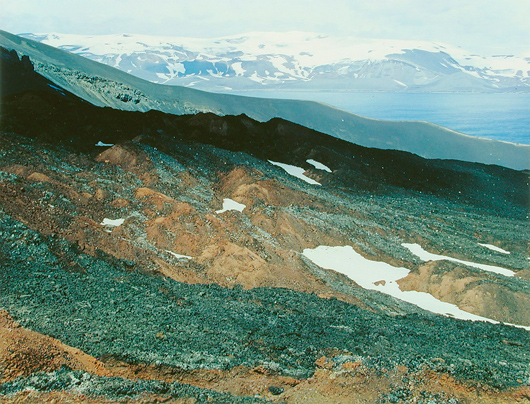
The Crater and Lava, Deception Island, Antarctica, by Eliot Porter 1975 |
The image above relies heavily upon the use of colour rather than tone to delineate the different strata of land created by the lava flows. The success of this picture is largely due to the fact that the palette is confined to muted shades of complementary turquoise and gold.
 | ||||||||||||||||||||||||||||||||||||||||||||||||||||||||||||||||||||||||||||||||||||||||||||||||||||||||||||||||||||||||||||||
| http://www.cartermuseum.org/sites/all/files/imce/education/P1990-58-7-10_s_0.jpg Sunset behind Las Tres Virgenes Volcano by Eliot Porter 1966 |
Whilst the image above of Las Tres Virgenes Volcano (shown above) also relies upon complementary colours for its impact and clarity, the strong composition of a slightly off-centre pathway that leads the eye through the scrub to the distant volcano plays an equally important role.
 | ||
|
Path
in Woods, Great Spruce Head Island, by Eliot Porter, 1981
|
The image of the path between the spruces (shown above) is equally deceptive in its apparent simplicity. This will have probably been a difficult subject to capture because of the poor light available between the trees. The subtlety of tone in this image is offset by the strong verticals of the tree trunks resulting in a strong yet quiet image that reveals the play of light upon the ground from between the trees.
Porter's use of simple composition and complementary colours is key to the success of his images. By contemporary standards however these images appear somewhat soft and therefore a little dated. It is a fact that photographic images - just like any other artform - follow trends in fashion, both regarding subject matter and execution.
John Blakemore (b.1936)
Blakemore is a self-taught English photographer from Coventry. His work is notable for its great subtlety of tone and he makes extensive use of both the zone system whilst capturing his images and darkroom techniques whilst processing his prints.
The image below of beach stones lapped by gentle waves has received a long exposure to create the milky texture of the moving water. Photographers frequently combine the use of this technique with strongly contrasted foreground elements to produce a slightly surreal image, but Blakemore has eschewed this approach in favour of a muted tonal range in which the beach stones seem drenched in light. The result is sensual rather than sensational and the eye is drawn to the softened forms of the foreground boulders before travelling upwards between them to the top third of the picture where stronger waves engulf craggier rocks.
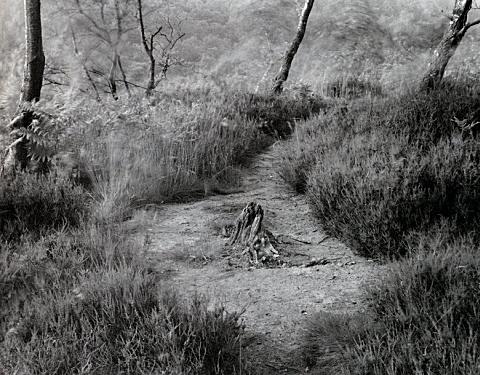
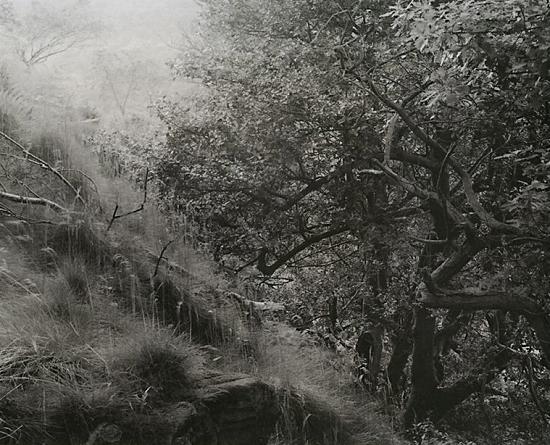
The two Blakemore images below capture small, intimate environments within a wild setting. The detail in both is sharpest at the midground and - like the beach image above - the viewer's eye is invited to travel a long a pathway provided by features on the right of the picture.
Porter's use of simple composition and complementary colours is key to the success of his images. By contemporary standards however these images appear somewhat soft and therefore a little dated. It is a fact that photographic images - just like any other artform - follow trends in fashion, both regarding subject matter and execution.
John Blakemore (b.1936)
Blakemore is a self-taught English photographer from Coventry. His work is notable for its great subtlety of tone and he makes extensive use of both the zone system whilst capturing his images and darkroom techniques whilst processing his prints.
The image below of beach stones lapped by gentle waves has received a long exposure to create the milky texture of the moving water. Photographers frequently combine the use of this technique with strongly contrasted foreground elements to produce a slightly surreal image, but Blakemore has eschewed this approach in favour of a muted tonal range in which the beach stones seem drenched in light. The result is sensual rather than sensational and the eye is drawn to the softened forms of the foreground boulders before travelling upwards between them to the top third of the picture where stronger waves engulf craggier rocks.
 | ||||||
|
Rocks & Tide, Friog, Wales by John Blakemore, 1977
|
The two Blakemore images below capture small, intimate environments within a wild setting. The detail in both is sharpest at the midground and - like the beach image above - the viewer's eye is invited to travel a long a pathway provided by features on the right of the picture.
 |
|
Path by John Blakemore, n.d.
|
 | |||||
The meditative quality of Blakemore's work relies heavily upon the subtlety of tonal range employed. His understanding of the zone system provides his photographs with an unusual level of detail and realism, whilst the close cropping of the images creates a sense of enclosure and intimacy.
Charlie Waite (b.1949)
Waite - recently described as 'the world's greatest living landscape photographer of his generation' by Hewlett Packard (Gallery, 2013) - originally worked in British theatre and television for the first ten years of his career. It is perhaps this background that gives his images such a strong presence; these landscapes are like beautifully lit, dramatic tableaux. Waite works through the medium of fine grained transparency film and simplicity of composition, strong tonal contrasts and scenery drenched in luminous colour are the hallmarks of his work. In an interview for the Trowbridge Gallery, Waite says that he is 'persistent and tenacious in pursuit of the perfect shot .. I knew what quality of light I was waiting for, and from what direction and how widespread it needed to be, but for me that is an accepted part of the procedure. This wish for light may not materialize, but I always remain hopeful that light will arrive and unlock the image (Gallery, 2013).'
In the image from the Dordogne above, Waite makes use of vertical rhythm to lead the eye along a corridor of trees toward the light-filled meadow at the far end. There is a fresh, clean sense to this image, due in no small part to the fact that these trees have been planted in an orderly way, very different to the muddle of wild vegetation photographed by John Blakemore.
Charlie Waite (b.1949)
Waite - recently described as 'the world's greatest living landscape photographer of his generation' by Hewlett Packard (Gallery, 2013) - originally worked in British theatre and television for the first ten years of his career. It is perhaps this background that gives his images such a strong presence; these landscapes are like beautifully lit, dramatic tableaux. Waite works through the medium of fine grained transparency film and simplicity of composition, strong tonal contrasts and scenery drenched in luminous colour are the hallmarks of his work. In an interview for the Trowbridge Gallery, Waite says that he is 'persistent and tenacious in pursuit of the perfect shot .. I knew what quality of light I was waiting for, and from what direction and how widespread it needed to be, but for me that is an accepted part of the procedure. This wish for light may not materialize, but I always remain hopeful that light will arrive and unlock the image (Gallery, 2013).'
 |
http://www.lightandland.co.uk/images/uploads/tutor_images/Charlie%20Waite/cwiv.jpg
Dordogne, France, by Charlie Waite |
 |
http://www.lightandland.co.uk/images/uploads/tutor_images/Charlie%20Waite/cwii.jpg
Buttermere II, Cumbria, England by Charlie Waite |
The image above from Buttermere is a far more traditional scene, brought to life by the sudden illumination of the oak tree in the centre of the image. Without this touch this photograph would probably look completely unremarkable.
 |
| http://www.lightandland.co.uk/images/uploads/tutor_images/Charlie%20Waite/cwix.jpg St Quirico D’Orcia I, Tuscany, Italy by Charlie Waite |
A similar use of dramatic light has been made in the image above from Tuscany, where a menacing sky glowers above a brightly lit field, the distant stand of dark cypresses holding the two elements together.
 |
The image above looks somewhat surreal, featuring a fence-like structure of unknown purpose on the shores of a loch, but the contrast of its shape and colour with the land and the echoes of its whiteness in the snow-capped peaks in the distance combine to create a pleasing composition.
 |
http://d2whyjh24t36y9.cloudfront.net/gallery/lupe/060505.jpg
Loch Indaal, Islay, Scotland by Charlie Waite |
The serene power of the Loch Indaal image above results from Waite's superb handling of the elements within a fairly traditional landscape scene, reminiscent of popular Victorian paintings. He has allowed a vast, dark sky to build at the top of the image and has burned the foreground base to create a kind of frame. This balances the extreme whiteness of the narrow strip of water, causing the image to read as a series of timeless horizontals against which only the calm cattle appear to occupy the present moment.
By comparison with the emotion inherent in the foregoing photographs, the two studies of American pasture-land below are quite abstract. In these images Waite has abandoned detail altogether in order to concentrate on the undulating forms of the land itself, allowing the light and shadow of late evening or early morning to describe the contours.
 |
http://d2whyjh24t36y9.cloudfront.net/gallery/lupe/050026.jpg
Washington State I, USA by Charlie Waite |
 |
|
Washington
State III, USA by Charlie Waite
|
Waite has an intrinsic understanding of the power of light to transform a landscape. His compositions also show restraint; by reducing the elements in a rich scene to only three or four, the resulting images contain emotion but avoid over-romanticism.
Jason Theaker (n.d.)
Theaker is a landscape photographer from Yorkshire who has taught animation, photography and digital manipulation for at Leeds College of Art and Bradford University. He also runs workshops in landscape photography. He describes his photographic aims as 'focused on capturing the pure environment, untainted by human intervention, coupled with the desire to seek out emotional impact thought the juxtaposition of contrasting compositional elements' (Jasontheaker.com, 2014).
His work is characterised by a tendency toward bold compositional statements and a high level of post production processing.
 |
 | ||
 |
 |
http://www.onlandscape.co.uk/wp-content/uploads/2012/03/5280376124_28e794bd93_o-1.jpg
Well Trodden Path by Jason Theaker |
Theaker has a great eye for capturing landscapes and for dramatic and appealing composition, but some of his post-production work is a little heavy-handed in places, giving the images a slightly hyper-real quality which I believe will probably date them quite quickly. Good post production processing should subtly enhance the image rather than detract from it.
Lee Beel (n.d.)
Beel is a professional freelance photographer and writer based in North Lincolnshire. His bright, clear landscapes have a modern, fresh feel to them and although they have undergone post-production processing it has not been at the cost to the integrity of the light within the scene.
Since all of the stone in the image above of sea-worn stacks is much the same in texture and colour this photograph could have easily appeared flat and bland. Adept post processing however has contributed a sense of depth by graduating the levels of contrast toward the foreground.
In the image below, the limestone outcrop clearly stands out from the surrounding landscape, but not to a ridiculous extent. Whilst the colours appear a little oversaturated, this is nonetheless a natural-looking rendition of the British landscape in comparison with the preceding images by Theaker and somewhat closer to the aesthetic I am aiming for in my work.
Beel is a professional freelance photographer and writer based in North Lincolnshire. His bright, clear landscapes have a modern, fresh feel to them and although they have undergone post-production processing it has not been at the cost to the integrity of the light within the scene.
 |
http://media.digitalcameraworld.com/files/2013/04/Famous_landscape_photographers_DCM79.out_tech2.middle.jpg
Untitled Image by Lee Beel |
Since all of the stone in the image above of sea-worn stacks is much the same in texture and colour this photograph could have easily appeared flat and bland. Adept post processing however has contributed a sense of depth by graduating the levels of contrast toward the foreground.
In the image below, the limestone outcrop clearly stands out from the surrounding landscape, but not to a ridiculous extent. Whilst the colours appear a little oversaturated, this is nonetheless a natural-looking rendition of the British landscape in comparison with the preceding images by Theaker and somewhat closer to the aesthetic I am aiming for in my work.
 | |||||||||||||||
http://media.digitalcameraworld.com/files/2013/04/Famous_landscape_photographers_DCM79.out_tech2.horiz_.jpg
Untitled Image by Lee Beel |
Andreas Gursky (B.1955)
Gursky trained in photography under Bernd and Hilda Becher and the influence of their minimalist restraint can be found in his series of Rhein waterscapes The image below 'Rhein ii' was recently sold in Christies, New York for $4.3 million. Taken with a medium format camera, Gursky scanned the original photograph into his computer and then digitally manipulated the image to erase the buildings on the far bank, leaving the photograph a series of horizontal strips as the water flows across the picture. Of this process, Gursky says: ‘I wasn’t interested in an unusual, possibly picturesque view of the Rhine, but in the most contemporary possible view of it. Paradoxically, this view of the Rhine cannot be obtained in situ; a fictitious construction was required to provide an accurate image of a modern river (Tate.org.uk, 2014).’
 |
|
Rhein
ii by Andreas Gursky
|
This print is a nice, sharp piece of modern design. It is not for this blog to argue whether it merits the extremely high monetary value that has been placed upon it, but the fact that a limited edition photographic print can now attract this level of collectability in today's society does actually offer some hope to photographers everywhere that the recent proliferation of amateur photographers does not necessarily spell the end for fine art landscape photography.
In addition to researching the images themselves for this project I also sought advice from photography sites on the best way to go about landscape photography. The two most useful tips I found were supplied by Digital Camera World, in which 25 professional photographers were invited to supply advice for successful working. In this article, Charlie Waite writes that he often looks 'to see where any conflicts lie and try and get the elements within the image to appear to be related and not in argument with one another..try to inject your work with some gravitas and use light to your advantage' whilst David Noton advises that '..what’s really the key is learning the tried and tested method of scouting a location, previsualising the light, planning a shoot and finally returning again and again until the conditions are perfect to create an award-winning image ..(Digitalcameraworld.com, 2012).'
In addition to researching the images themselves for this project I also sought advice from photography sites on the best way to go about landscape photography. The two most useful tips I found were supplied by Digital Camera World, in which 25 professional photographers were invited to supply advice for successful working. In this article, Charlie Waite writes that he often looks 'to see where any conflicts lie and try and get the elements within the image to appear to be related and not in argument with one another..try to inject your work with some gravitas and use light to your advantage' whilst David Noton advises that '..what’s really the key is learning the tried and tested method of scouting a location, previsualising the light, planning a shoot and finally returning again and again until the conditions are perfect to create an award-winning image ..(Digitalcameraworld.com, 2012).'
With this advice in mind I began to plan my shoots over the summer and drew up a schedule.
_________________________________________________________________
Planning
Schedule
for Negotiated Studies One: Landscapes
TASK
|
DETAILS
|
DEADLINE
|
Find subjects:
|
Cae
Ddu / Moelwyns;
Llyn
Manod;
Llyn
Cwmorthin;
Moel Dyrnogydd
|
31 Oct
|
Research
landscape photography
|
Research notable
landscape photographers, past and present. Examine angles,
viewpoints, composition and post production values. Make note of
any advice.
|
30 July
|
Transport and
accessibility
|
Research access
|
02 March
|
Schedule:
|
Cae
Ddu / Moelwyns;
Llyn
Manod;
Moel
Dyrnogydd;
Llyn Cwmorthin.
|
June - Aug
July
- Aug
July - Nov
Sept - Nov
|
Editing &
Post Production
|
Continuous
|
06 Jan
|
Update online
Journal
|
Upload research
images to journal together with all written research, links to external
sites and a selection of my own images from sites recorded for this project.
Upload
images to Flickr account and Facebook Photography page
|
21
Jan
|
Email Tutors
|
Email all links to
tutors: Blogger, Flickr, Fb page
|
28 Jan
|
* Blue
– task completed
Black – to do
Red
– to do urgent
_________________________________________________________________
Photographic Journal
Landscapes One - July, Llyn Manod
Using concepts drawn from from the above researches I developed several lines of ideas to explore. I was particularly interested by the idea of working with a foreground, middle ground and background and this influenced my choice of locations. In another line of investigation I wanted to practice recording waterscapes in order to see what could be achieved with my Canon 60d camera.
During the second half of the summer I therefore spent every available dry day photographing my local area, beginning with a walk up to Llyn Manod, the lake that nestles between the two peaks of Manod Bach and Manod Mawr. Even during the brief mountain summer this is a bleak spot - not always easy to work in because of the constant wind - but the utter simplicity of the forms afforded by the mountains and the shadows they create in the early morning and toward late afternoon allow for pleasingly strong compositions. I endeavoured to capture the sense of isolation which pervades this area, but without a polarising filter (which I have since acquired) found it difficult to capture the waterscape without light being reflected from the surface.
 |
| Llyn Manod, southern end |
Back home I opened these images in Adobe Photoshop's Camera Raw editor and found that several of them worked more successfully when converted to black and white. The blue haze from the ever-present high water content in the atmosphere of this location had marred them as colour photographs but lent the images a kind of gentleness when converted to soft greys.
 |
| Llyn Manod, northern end |
 |
| Approach to Llyn Manod |
After capturing the lake from each end I photographed views
of the landscape that can be seen from the high vantage point, stretching all the way to the sea at the Portmeirion estuary. Unfortunately these too were similarly marred by both haze and glare as can be seen in the uncertain tonality of the image below; a set of
graduated filters (also now obtained) would have done much to improve these
shots, although again several of these images converted well both to black and white and also indigo monochrome.
 |
| View towards Trawsfynnydd from Manod Bach |
 |
| View toward Portmeirion from Manod Bach |
 |
| Indigo Monochromatic view toward Portmeirion from Manod Bach |
On a subsequent visit to that same area I was able to capture a couple of further shots that I was pleased with of a drystone wall with rotted fence-posts poking through gaps between the stones beside an ancient twisted hawthorn.
 |
| Hawthorn and Fallen Wall, Manod Bach |
 |
| Fallen Wall, Manod Bach |
Landscapes Two - August, Stream
During the following days I also attempted to capture the motion blur of
a local stream - again such filters would have enabled me to take a more
successful set of images at the time – but lacking these at the time I ventured out at dusk over the course of three evenings in the hope that the reduced light would permit me a longer exposure time whilst avoiding too many overblown highlights. The experience was an interesting one
that increased my understanding of camera controls and the balances necessary to
establish a successful balance between shutter speed and aperture width, but even by the third day of practise the resulting images were still a little too bright and necessitated a lot of post production work to bring them back to an acceptable level.
 |
| Little Waterfall |
Landscapes Three - August, Manod Bach
Over the following weeks I took a great many pictures of the scenery around the slopes of Manod Bach, the smaller of the two mountains that overlooks my house. Having not yet definitively decided on an overriding theme for my final collection I tried to capture a wide selection of interesting images, with the intention of developing one or more of the ideas when the opportunity presented itself. Inspired by Charlie Waite's approach, one such idea I pursued was that of the unusual juxtaposition of light and shadow, of which three examples can be seen below. In the first photograph the bent gate - ostensibly the most interesting subject in the picture - is in deep shadow whilst the distant mountains can be clearly seen. Whilst this image is not particularly inspiring in itself, I feel that it does contain elements that I will be able to develop on future visits to this nearby location.
 |
| Bent Gate and distant Moelwyns |
In the second image (below), the distant shadow on the mountain and the nearby one falling on the stones occupy different halves of the picture. Again this is an experiment that doesn't quite come off because the foreground stones are a little too close to the viewer and the eye is consequently drawn by the forms rather than the shadow. It is an idea worth revisiting though.
 |
| Manod Mawr and Boulders |
The shadow in the slightly more successful third image - below - helps define the strong 'zig-zag' shape created by the two mountain ridges and the two walls. I had to wait for some twenty minutes to obtain this shot but felt that the wait was well worthwhile. This shot would have worked better however if I had stood closer to the mountains.
 |
| Manod Bach and Manod Mawr |
Landscapes Four - September, Sunsets
Another idea I explored during this time was that of sunsets taken from unusual vantage points. (Although the image of Manod Mawr below isn't taken from a particularly unusual angle in itself I was pleased by the way the mountain and its foothills is shown in complete isolation from any other terrain and conveys its strong and slightly forbidding nature.)
 |
| Manod Mawr, sunset |
Using manual settings to provide long exposures I tried to get as low to the ground as possible in order to capture the last of the sunlight spilling over the ridges in the four shots below. I have always been fascinated by the graduated colour that fills a clear sky as the sun goes down and therefore these shots were an attempt to combine this phenomenon with an interesting feature at ground level. Although the resulting images are pleasant enough to look at I do not think combining two subjects in this way is altogether successful, since the viewer doesn't really know which element of the image they are supposed to be focussing on.
 |
| Wire and Sunset, Manod Bach |
 |
| Boulders and Sunset, Manod Bach |
 |
| Sunset through gap in a Wall, Manod Bach |
 |
| Moelwyn Sunset from Manod Bach |
Landscapes Five
- September, Moel Dyrnogydd
Having
captured many landscape shots over the summer within my local
mountains: Manod Bach, Manod Mawr and the Moelwyn range, I took the
opportunity offered by a friend to join her and a few of her friends
for a spontaneous walk across the mountainside bordering the section
of the A470 known as the Crimea Pass - having been there once many
years before I knew it would afford some spectacular views. Our walk took us across the top of Moel Dyrnogydd - the mountain
through which the Conwy Valley Railway tunnel was bored in 1881 to
facilitate the transport of slate from the mines of Blaenau
Ffestiniog through the Lledr Valley to the coast beyond. At two and
a half miles in length this tunnel is the longest single track
railway tunnel in Britain and cylindrical ventilation towers have
been built at intervals along the mountain top above it, much to the
bewilderment of tourists who have been known to mistake these tall,
windowless stone structures for some kind of ancient fort, see below.
 |
| Ventilation Tower, Moel Dyrnogydd |
The long
walk actually turned out to be exceptionally brisk and with only
brief moments to capture the views before my companions strode around
the next hill and disappeared from sight and sound I had no
opportunity to use my tripod, relying instead upon the image
stabilization feature built into my Canon lens to steady my shots.
Often covered in low lying cloud due to its high altitude, this vast landscape is absolutely breathtaking on a clear day and rather than focus on any one particular spot I endeavoured to capture the rhythm of the many interfolded layers of land and the way that the clouds cast enormous shadows over the mountains, creating a counterpoint of light and shadow. As often happens in Blaenau Ffestiniog on a fine day there was a great deal of blue haze in the air from the moisture evaporating off the mountain peat bogs and consequently much of the distant detail was obscured.
Often covered in low lying cloud due to its high altitude, this vast landscape is absolutely breathtaking on a clear day and rather than focus on any one particular spot I endeavoured to capture the rhythm of the many interfolded layers of land and the way that the clouds cast enormous shadows over the mountains, creating a counterpoint of light and shadow. As often happens in Blaenau Ffestiniog on a fine day there was a great deal of blue haze in the air from the moisture evaporating off the mountain peat bogs and consequently much of the distant detail was obscured.
 |
| Looking North from Moel Dyrnogydd |
 |
| Looking North-East from Moel Dyrnogydd |
 |
| Looking towards Dolwyddelan and Denbigh from Moel Dyrnogydd |
 |
| Looking towards Dolwyddelan and Denbigh from Moel Dyrnogydd |
Back home I used Adobe Photoshop’s
Camera Raw Editor to reduce the blues in order to reveal the farther
mountains and applied graduated amounts of contrast across each image in order to develop a sense of the landscape receding into the distance. Following the advice of Senior Photography Lecturer Stewart
Edwards I initially intended to revisit this walk later in the year to capture
the scenery under different conditions and this time making use of both a
tripod and a telephoto lens, but unfortunately the winter weather
conditions on the few occasions that I was back in Blaenau
Ffestiniog, combined with the prior family commitments of my friend
(who could drive me there) dictated otherwise.
My final selection of photographs from this walk were chosen because I felt that they capture the breadth of the landscape and distant mountains whilst presenting them as natural, abstract patterns. Although they required several sessions of post-production processing to reduce the blues still further, I am quite pleased with these images and will present them as part of my End of Year Show. The eight images selected are displayed in a thumbnail composite in the Summary section of this journal, but this link will also take the reader to a low resolution copy of these final images on my Flickr Infinite Sky Photography Page, whilst a copy of the images shown in this journal may be found here.
My final selection of photographs from this walk were chosen because I felt that they capture the breadth of the landscape and distant mountains whilst presenting them as natural, abstract patterns. Although they required several sessions of post-production processing to reduce the blues still further, I am quite pleased with these images and will present them as part of my End of Year Show. The eight images selected are displayed in a thumbnail composite in the Summary section of this journal, but this link will also take the reader to a low resolution copy of these final images on my Flickr Infinite Sky Photography Page, whilst a copy of the images shown in this journal may be found here.
Landscapes Six
- November, Llyn Cwmorthin
In November I travelled up to Cwmorthin Quarry near Blaenau Ffestiniog to photograph the abandoned quarrymen's cottages and Rhosydd Chapel for my 'Abandoned Spaces' project. Whilst there, I took the opportunity to add some more waterscapes to my collection, photographing both Llyn Cwmorthin and the river that leaves it to cascade down the mountainside. The shots of the river were dramatic but a little too overexposed and I was more pleased with those of Llyn Cwmorthin itself where the light - being later in the day - was more mellow and golden. Again, these were pleasant enough shots but lack a clarity of subject matter and therefore will not be making it into my final selection of images, which remain those taken on Moel Dyrnogydd.

Afon Cwmorthin

Afon Cwmorthin

Llyn Cwmorthin

Llyn Cwmorthin


Afon Cwmorthin

Llyn Cwmorthin

Llyn Cwmorthin
________________________________________________________________
Summary
Processing of the final images took longer than expected since pulling back the high amounts of blue in the images to reveal the details without muddying the colours took several attempts. Careful cropping was another consideration, because even a few millimetres to one side or the other of the images made a noticeable difference to the meaning of the image. With the guidance of Senior Photography Lecturer Stewart Edwards however I was able to arrive at a shortlist of eight images which will be printed at A3 size and displayed for my Final Exhibition. A thumbnail composite of the chosen images is displayed below.
________________________________________________________________
This has been an enjoyable project to undertake and my researches have expanded and deepened my knowledge of both the requirements of the genre of landscape photography and of the relevant post-production techniques. In particular, I have developed a greater awareness of contemporary practice with regard to post-production processing as a direct result of advice from senior Photography Lecturer Stewart Edwards who guided me through the stages necessary to bring my final selection of images up to professional standards. Because of this my confidence in this aspect of working has increased considerably.
It is a source of regret that due to inclement weather I was unable to revisit the site of my final selection of images for a second session during this project. Given the opportunity to do so I would have used a tripod plus a remote control shutter release for increased stability and experimented with a telephoto lens and my newly acquired graduated neutral density filter. These four elements in combination would have allowed me to explore aspects of the landscape at a depth that I was unable to achieve at the time of my original visit. The possibility that I would have been able to reproduce some of the landscapes that I had recorded under a different light and with autumnal and winter colours is something I am sad to have missed. In the future I hope to return to the area fully equipped and take the photographs that are currently in my imagination.
Having acquired a deeper understanding of the technical and aesthetic requirements of working in this genre as a result of undertaking this project, I intend to continue working in this field for the foreseeable future with the intention of eventually selling prints of my work.
Summary
Processing of the final images took longer than expected since pulling back the high amounts of blue in the images to reveal the details without muddying the colours took several attempts. Careful cropping was another consideration, because even a few millimetres to one side or the other of the images made a noticeable difference to the meaning of the image. With the guidance of Senior Photography Lecturer Stewart Edwards however I was able to arrive at a shortlist of eight images which will be printed at A3 size and displayed for my Final Exhibition. A thumbnail composite of the chosen images is displayed below.
 |
| Landscapes to be printed: Moel Dyrnogydd |
________________________________________________________________
Evaluation
This has been an enjoyable project to undertake and my researches have expanded and deepened my knowledge of both the requirements of the genre of landscape photography and of the relevant post-production techniques. In particular, I have developed a greater awareness of contemporary practice with regard to post-production processing as a direct result of advice from senior Photography Lecturer Stewart Edwards who guided me through the stages necessary to bring my final selection of images up to professional standards. Because of this my confidence in this aspect of working has increased considerably.
It is a source of regret that due to inclement weather I was unable to revisit the site of my final selection of images for a second session during this project. Given the opportunity to do so I would have used a tripod plus a remote control shutter release for increased stability and experimented with a telephoto lens and my newly acquired graduated neutral density filter. These four elements in combination would have allowed me to explore aspects of the landscape at a depth that I was unable to achieve at the time of my original visit. The possibility that I would have been able to reproduce some of the landscapes that I had recorded under a different light and with autumnal and winter colours is something I am sad to have missed. In the future I hope to return to the area fully equipped and take the photographs that are currently in my imagination.
Having acquired a deeper understanding of the technical and aesthetic requirements of working in this genre as a result of undertaking this project, I intend to continue working in this field for the foreseeable future with the intention of eventually selling prints of my work.
_______________________________________________________________
References
Adams, A. 1942. The Tetons and the Snake River. [image online]
Available at: http://www.standard.co.uk/incoming/article8294659.ece/ALTERNATES/w620/The-Tetons-and-the-Snake-Ri.jpg
[Accessed: 20 Jun 2013].
Adams, A. 1937. Clearing Winter Storm. [image online]
Available at: http://www.standard.co.uk/incoming/article8294651.ece/ALTERNATES/w620/Clearing-Winter-Storm%2C-Yose.jpg
[Accessed: 20 Jun 2013].
Adams, A. 1960. Northern Cascade. [image online]
Available at: http://www.standard.co.uk/incoming/article8294650.ece/ALTERNATES/w620/Waterfall%2C-C.jpg
[Accessed: 20 Jun 2013].
Adams, A. [n.d.]. Mountains. [image online]
Available at: http://crossfitwilmette.com/wp-content/uploads/2012/11/Ansel-Adams-Mountains.jpg
[Accessed: 20 Jun 2013].
Adams, A. [n.d.]. Minarets Spires. [image online]
Available at: http://ngm.nationalgeographic.com/2011/10/ansel-adams-wilderness/img/01-minarets-spires-670.jpg
[Accessed: 20 Jun 2013].
Beel, L. 2013. Limestone Stacks, Beach. [image online]
Available at: http://media.digitalcameraworld.com/files/2013/04/Famous_landscape_photographers_DCM79.out_tech2.middle.jpg
[Accessed: 22 Jul 2013].
Beel, L. 2013. Limestone Stack, Moor. [image online]
Available at: http://media.digitalcameraworld.com/files/2013/04/Famous_landscape_photographers_DCM79.out_tech2.horiz_.jpg
[Accessed: 22 Jul 2013].
Blakemore, J. [n.d.] Trees. [image online]
Available at: http://web.ncf.ca/ek867/john.blakemore.trees.jpg
[Accessed: 11 Jul 2013].
Blakemore, J. [n.d.] Path. [image online]
Available at: http://web.ncf.ca/ek867/john.blakemore.path.jpg
[Accessed: 11 Jul 2013].
Blakemore, J. 1977. John Blakemore (b.1936) Rocks & Tide, Friog, Wales. [image online]
Available at: http://www.liveauctioneers.com/item/11537000_john-blakemore-b1936-rocks-and-tide-friog-wales
[Accessed: 11 Jul 2013].
Cartermuseum.org. 2013. Eliot Porter: About Eliot Porter. [online]
Available at: http://www.cartermuseum.org/collections/porter/about.php
[Accessed: 21 June 2013].
Charliewaite.com. 2013. [online]
Available at: http://www.charliewaite.com/gallery
[Accessed: 18 Jul 2013].
Digitalcameraworld.com. 2012. 50 photography tips from jobbing pros to famous photographers | Digital Camera World. [online]
Available at: http://www.digitalcameraworld.com/2012/03/16/50-photography-tips-from-jobbing-pros-to-famous-photographers/
[Accessed: 27 Jul 2013].
Eftaiha, D. 2013. Diana Eftaiha (graceofrox) on Twitter. [online]
Available at: https://twitter.com/graceofrox
[Accessed: 23 June 2013].
Eftaiha, D. 2013. Understanding & Using Ansel Adam's Zone System – Photography – Tuts+. [online]
Available at: http://photography.tutsplus.com/tutorials/understanding-using-ansel-adams-zone-system--photo-5607
[Accessed: 23 June 2013].
Gallery, T. 2013. TROWBRIDGE - Artist - Charlie Waite. [online]
Available at: http://www.trowbridgegallery.com/artists-info.php?TSADID=4
[Accessed: 17 Jul 2013].
Gursky, A. 2013. Rhein ii. [image online]
Available at: http://www.tate.org.uk/art/images/work/P/P78/P78372_9.jpg
[Accessed: 9 Aug 2013].
Jasontheaker.com. 2013. Home. [online]
Available at: http://www.jasontheaker.com/
[Accessed: 2 Aug 2013].
Kcbx.net. 2013. Group f/64. [online]
Available at: http://kcbx.net/~mhd/1intro/f64.htm
[Accessed: 20 Jun 2013].
Lee-beel-photography.co.uk. 2013. Lee Beel Photography Barton on Humber Lincolnshire dogs hounds horses natural wildlife portraits. [online]
Available at: http://www.lee-beel-photography.co.uk/
[Accessed: 29 Jul 2013].
Lightandland.co.uk. 2013. Light and Land Photographic Tour Leader Charlie Waite - Light and Land Photography Workshops. [online]
Available at: http://www.lightandland.co.uk/photography-tour-tutors/view/charlie-waite
[Accessed: 16 Jul 2013].
Porter, E. 1975. The Crater and Lava, Deception Island, Antarctica, 1975. [image online]
Available at: http://sfonline.barnard.edu/ice/images/glasberg/figure1.jpg
[Accessed: 21 Jun 2013].
Porter, E. 1981. Path in Woods, Great Spruce Head Island, Maine. [image online]
Available at: http://www.getty.edu/art/exhibitions/porter/images/13807201.jpg [Accessed: 22 Jun 2013].
Porter, E. 1966. Sunset behind Las Tres Virgenes Volcano. [image online] Available at: http://www.cartermuseum.org/sites/all/files/imce/education/P1990-58-7-10_s_0.jpg
[Accessed: 21 Jun 2013].
Tate.org.uk. 2013. 'The Rhine II', Andreas Gursky | Tate. [online]
Available at: http://www.tate.org.uk/art/artworks/gursky-the-rhine-ii-p78372/text-summary
[Accessed: 9 Aug 2013].
Theaker, J. 2013. Home. [online]
Available at: http://www.landscapeinspired.com/
[Accessed: 5 Aug 2013].
Theaker, J. 2013. Limestone Pavements. [image online]
Available at: http://www.landscapeinspired.com/photos/Malham/theakerj08.jpg [Accessed: 5 Aug 2013].
Theaker, J. 2013. Sense of Irony. [image online]
Available at: http://www.landscapeinspired.com/photos/5445477911_2c5364257e_o.jpg
[Accessed: 5 Aug 2013].
Theaker, J. 2013. Test. [image online]
Available at: http://www.landscapeinspired.com/5890359600_268d4b85bd_b.jpg
[Accessed: 5 Aug 2013].
Theaker, J. 2013. Well Trodden Path. [image online]
Available at: http://www.onlandscape.co.uk/wp-content/uploads/2012/03/5280376124_28e794bd93_o-1.jpg
[Accessed: 5 Aug 2013].
The Evening Standard. 2012. Ansel Adams: Photography from the Mountains to the Sea, National Maritime Museum, SE10 - review. [online]
Available at: http://www.standard.co.uk/goingout/exhibitions/ansel-adams-photography-from-the-mountains-to-the-sea-national-maritime-museum-se10--review-8297082.html?action=gallery
[Accessed: 20 Jun 2013].
Turnage, R. 1980. Ansel Adams: The Role of the Artist in the Environmental Movement. [online]
Available at: http://www.anseladams.com/ansel-adams-the-role-of-the-artist-in-the-environmental-movement/
[Accessed: 19 Jan 2013].
Waite, C. 2013. Buttermere II, Cumbria, England. [image online]
Available at: http://www.lightandland.co.uk/images/uploads/tutor_images/Charlie%20Waite/cwii.jpg
[Accessed: 18 Jul 2013].
Waite, C. 2013. Dordogne, France. [image online]
Available at: http://www.lightandland.co.uk/images/uploads/tutor_images/Charlie%20Waite/cwiv.jpg
[Accessed: 18 Jul 2013].
Waite, C. 2013. Inchnadamph, Scotland. [image online]
Available at: http://d2whyjh24t36y9.cloudfront.net/gallery/lupe/060503.jpg
[Accessed: 18 Jul 2013].
Waite, C. 2013. Loch Indaal, Islay, Scotland. [image online]
Available at: http://d2whyjh24t36y9.cloudfront.net/gallery/lupe/060505.jpg
[Accessed: 18 Jul 2013].
Waite, C. 2013. St Quirico D’Orcia I, Tuscany, Italy. [image online]
Available at: http://www.lightandland.co.uk/images/uploads/tutor_images/Charlie%20Waite/cwix.jpg
[Accessed: 18 Jul 2013].
Waite, C. 2013. Washington State I, USA. [image online]
Available at: http://d2whyjh24t36y9.cloudfront.net/gallery/lupe/050026.jpg
[Accessed: 18 Jul 2013].
Waite, C. 2013. Washington State III, USA. [image online]
Available at: http://www.lightandland.co.uk/images/uploads/tutor_images/Charlie%20Waite/cwx.jpg
[Accessed: 18 Jul 2013].